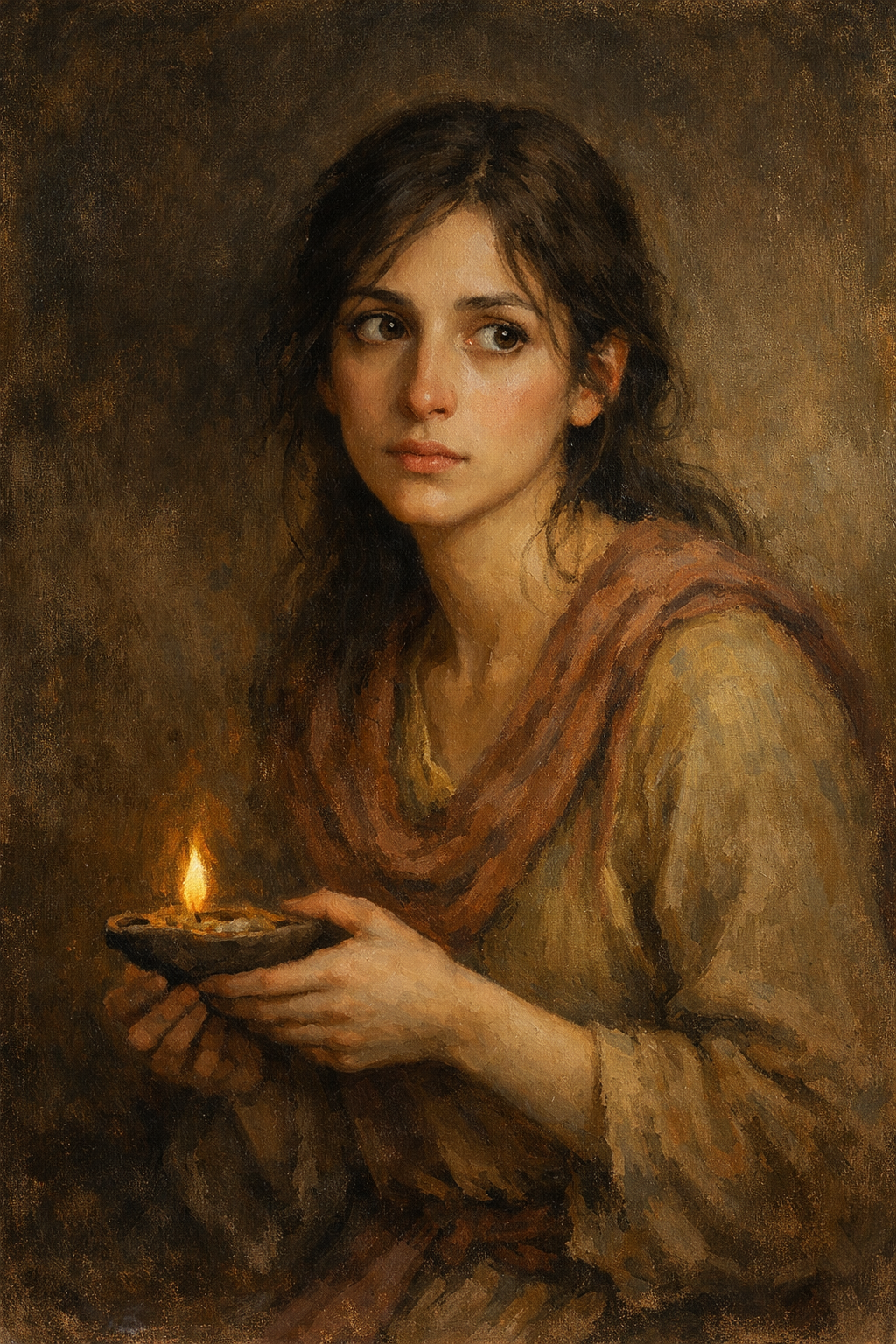
Rachel’s Story
Rachel is introduced as the younger daughter of Laban, the sister of Leah. Scripture notes the difference between the sisters without explanation or defense: “Leah’s eyes were weak, but Rachel was beautiful in form and appearance.” (Genesis 29:17) From the beginning, they are known together, shaped by birth order and proximity, and placed within the same household where comparison is unavoidable and inheritance follows rules that do not bend easily for affection.
Jacob arrives in the land of his mother’s family alone, having fled from his brother. Near Haran, he finds shepherds gathered around a well, waiting for all the flocks to be assembled before the stone is rolled away. When he asks about Laban the son of Nahor, they tell him they know him, and that his daughter Rachel is coming with the sheep. While they are still speaking, Rachel arrives, leading her father’s flock, for she was a shepherdess. Jacob steps forward and rolls the stone from the mouth of the well himself, then waters the flock of Laban his mother’s brother. Afterward he kisses Rachel and weeps aloud, and tells her that he is her father’s kinsman, the son of Rebekah. Rachel runs to tell her father, and the exchange has the ease of people who recognize connection quickly, even if neither yet understands how fully their lives are about to be joined.
Laban welcomes Jacob into his house and says, “Surely you are my bone and my flesh!” (Genesis 29:14). Jacob stays with him and works for him. After a month, Laban says, “Because you are my kinsman, should you therefore serve me for nothing? Tell me, what shall your wages be?” Jacob answers without hesitation, speaking plainly and publicly: “I will serve you seven years for your younger daughter Rachel.” (Genesis 29:18) Scripture records that Jacob loved Rachel, and that the seven years seemed to him but a few days because of that love, making clear that his attachment is visible, sustained, and known within the household, even as Rachel’s future remains subject to her father’s authority.
When the seven years are completed, Laban gathers the men of the place and makes a feast. But in the evening, he takes Leah his daughter and brings her to Jacob. It is not until morning that Jacob realizes what has happened. He confronts Laban, saying, “What is this you have done to me? Did I not serve with you for Rachel? Why then have you deceived me?” (Genesis 29:25) Laban answers that it is not the custom in that place to give the younger before the firstborn. Rachel is given to Jacob after the wedding week, and Jacob serves another seven years for her. Rachel enters marriage knowing she was deeply wanted and fully worked for, yet also knowing that her desires were negotiated around tradition, and that her place in the family was determined less by love than by order.
Scripture states simply, “Jacob loved Rachel more than Leah.” (Genesis 29:30) When the LORD sees that Leah is unloved, He opens her womb. Rachel does not conceive. As Leah bears son after son, Rachel remains without a child, living beside her sister as status and security accumulate in ways Rachel cannot access. The rivalry between them is not sudden or sharp, but slow and daily, shaped by shared space and unequal outcomes. In time, Rachel speaks to Jacob with urgency and says, “Give me children, or I shall die!” (Genesis 30:1) Her words reflect years of waiting and fear rather than a single outburst. Jacob answers sharply, “Am I in the place of God, who has withheld from you the fruit of the womb?” and the strain between them is named but not resolved, leaving Rachel to carry both love and disappointment at once.
Rachel gives her servant Bilhah to Jacob and says, “Here is my servant Bilhah; go in to her, so that she may give birth on my behalf, that even I may have children through her.” (Genesis 30:3) This decision places Rachel in a position of authority over another woman even as she remains powerless over her own circumstances. When Bilhah bears a son, Rachel names him Dan and says, “God has judged me, and has also heard my voice and given me a son.” When a second son is born, Rachel names him Naphtali and says, “With mighty wrestlings I have wrestled with my sister and have prevailed.” (Genesis 30:6–8) Through these names, Rachel gives voice to a struggle that has shaped her life, acknowledging both relief and rivalry without hiding either.
Leah continues to bear sons. Rachel remains without a child of her own until Scripture records a turning point without elaboration: “Then God remembered Rachel, and God listened to her and opened her womb.” (Genesis 30:22) Rachel conceives and bears a son. She names him Joseph and says, “God has taken away my reproach.” Her words recognize years of quiet disgrace now lifted, though not erased. She adds, “May the LORD add to me another son,” speaking with hope shaped by how long fulfillment has taken and how fragile it has proven to be.
When Jacob prepares to leave Laban, Rachel goes with him. As they flee, Rachel takes her father’s household gods. Scripture does not explain why, only records that she takes something bound to her father’s house as she leaves it, suggesting that separation from her past, and from her father’s control, is neither simple nor complete. When Laban overtakes them and searches the tents, Rachel hides the gods in the saddle and sits on them, saying to her father, “Let not my lord be angry that I cannot rise before you, for the way of women is upon me.” (Genesis 31:35) The gods are not found, and the moment passes without confrontation, leaving unresolved tensions behind them.
As Jacob travels toward Ephrath, Rachel becomes pregnant again. The labor is hard, and as her life is leaving her, the midwife says, “Do not fear, for you have another son.” (Genesis 35:17) Rachel names him Ben-oni, giving voice to the pain of the moment. Jacob calls him Benjamin. Rachel dies and is buried on the way to Ephrath, that is, Bethlehem. She does not reach the place where the family finally settles, and her story ends while the journey is still underway. Jacob sets up a pillar over her grave, marking the loss openly and permanently.
Rachel’s story continues beyond her lifetime. The prophet later speaks of her as a mother bound to the fate of her children: “A voice is heard in Ramah, lamentation and bitter weeping. Rachel is weeping for her children; she refuses to be comforted, because they are no more.” (Jeremiah 31:15)
Rachel’s life is told through work faithfully done, love deeply given, longing openly spoken, and relationships that never resolve cleanly. She is loved, yet limited; heard by God, yet shaped by waiting; central to the family’s future, yet unable to escape its cost. Scripture leaves her not as a lesson, but as a presence — one whose voice continues to matter long after her life ends.
Household gods, often called teraphim, were small idols kept within a family home in the ancient world. They were closely tied to family identity, authority, and inheritance, and possession of them could signal who held legitimate standing within the household. They were not simply objects of private devotion, but symbols of control and continuity passed down through generations.
When Rachel takes her father’s household gods as Jacob’s family flees, she is taking something that represents her father’s authority and claim over his household. Scripture does not state her motive, but the act would have been understood as serious and confrontational in her time. It could signal resistance to her father’s control, a claim to belonging or inheritance, or an unresolved attachment to the household she is leaving. The fact that Rachel hides the gods and lies to protect herself shows that the break is not clean. She leaves her father’s house carrying both defiance and fear, and the narrative moves forward without resolving the tension, allowing the moment to stand as a quiet but revealing act within her story.
In the world Rachel and Bilhah lived in, their relationship was defined by hierarchy. Bilhah was Rachel’s servant, given to her as part of the household arrangement, and legally belonged to Rachel’s household rather than acting independently. When Rachel gives Bilhah to Jacob, she is exercising recognized authority within that system, not negotiating as an equal. Bilhah’s body and labor are treated as extensions of Rachel’s position in the family.
When Bilhah bears children, those children are legally considered Rachel’s. This is why Rachel names them and interprets their births in her own words, saying, “God has judged me,” and later, “With mighty wrestlings I have wrestled with my sister.” The children secure Rachel’s standing within the household, even though Bilhah carries the pregnancies and gives birth. In this system, motherhood is divided: Bilhah bears the cost, while Rachel receives the social outcome.
This arrangement does not imply closeness or consent between the women. It reflects a structure where one woman’s loss is addressed through another woman’s body, binding them together in a relationship that is functional, intimate, and unequal. Scripture records the arrangement without endorsing it, showing how family survival and status were often secured at the expense of those with the least power.
Who Would She Be Today?

If Rachel lived today, she would be a woman who works hard and is visibly capable, someone trusted with responsibility and accustomed to being noticed without seeking attention. People would be drawn to her easily, and she would enter love with hope and commitment, believing it would lead to the life she wants. Instead, she would find herself caught in family expectations and decisions made by others, watching what she longs for most — stability, children, a settled sense of belonging — arrive first for someone else.
She would live with jealousy that she does not excuse or hide, especially when family life forms around her while she remains on the edges of it. She would want a home filled with children, not as a symbol, but as proof that she truly belongs. When waiting becomes too heavy, she would take responsibility in imperfect ways, trying to build a family by whatever means are available to her, even when those choices complicate her relationships further. She would not be weak or passive, but she would carry a deep, persistent longing — for family, for permanence, and for the life she believed love had promised but never fully delivered.
Where Rachel Appears in Scripture
Genesis 29:6–12
Rachel appears for the first time, arriving at the well with her father’s sheep; Jacob waters the flock, kisses her, weeps, and tells her he is her kinsman. Rachel runs and reports this to her father.
Genesis 29:16–18
Rachel is identified as Laban’s younger daughter; she is described in contrast to Leah. Jacob states his desire to marry Rachel and agrees to serve seven years for her.
Genesis 29:20
Rachel is the reason Jacob’s years of service are described as seeming short because of his love for her.
Genesis 29:25–30
Rachel is withheld on the wedding night, then given to Jacob after Leah; Jacob marries Rachel and serves an additional seven years. Scripture states Jacob loved Rachel more than Leah.
Genesis 30:1–8
Rachel speaks directly to Jacob about her barrenness. She gives her servant Bilhah to Jacob. Rachel names Bilhah’s sons Dan and Naphtali and explains the names.
Genesis 30:22–24
God remembers Rachel; she conceives and gives birth to Joseph. Rachel names him and speaks about the removal of her reproach and her desire for another son.
Genesis 31:19
Rachel takes her father’s household gods as Jacob’s family prepares to leave Laban.
Genesis 31:32–35
Rachel is present during Laban’s search for the household gods; she hides them and speaks to her father to avoid rising.
Genesis 33:1–2
Rachel is listed among Jacob’s wives as he prepares to meet Esau; Joseph is placed with her.
Genesis 35:16–20
Rachel gives birth to her second son during difficult labor; she names him Ben-oni and dies. Jacob renames the child Benjamin and buries Rachel near Ephrath (Bethlehem), setting up a pillar over her grave.
Genesis 46:19
Rachel is referenced in the genealogy of Jacob’s family entering Egypt; Joseph and Benjamin are listed as her sons.
Ruth 4:11
Rachel is referenced alongside Leah in a blessing spoken over Ruth, acknowledging her role in building the house of Israel.
Jeremiah 31:15
Rachel is referenced symbolically as a mother weeping for her children, connected to the loss of her descendants.
Matthew 2:18
Jeremiah’s reference to Rachel is quoted in the New Testament in connection with the mourning following Herod’s massacre of the children in Bethlehem.
Legacy
Within Christian teaching and tradition, Rachel has often been remembered first as the beloved wife — the woman Jacob loved deeply and worked many years to marry. Her story has been used to speak about romantic devotion, longing, and the pain of waiting, especially in conversations about marriage and desire. At the same time, her barrenness has frequently been treated as a problem to be solved rather than a lived reality to be understood, with the focus moving quickly to her eventual motherhood and away from the years that shaped her faith, her voice, and her place within the family.
Rachel’s rivalry with Leah has sometimes been framed too simply, cast as jealousy or weakness, without enough attention to the household structure that created constant comparison and insecurity for both sisters. In some Christian readings, Rachel is contrasted unfavorably with Leah, as though fruitfulness were a moral measure, or as though God’s care could be reduced to visible outcomes. These interpretations often go beyond the text, which records Rachel’s longing, frustration, and speech honestly but does not condemn her for them.
Her use of Bilhah and her naming of Dan and Naphtali have also been read harshly at times, as evidence of manipulation or lack of faith. Yet many modern Christian readers are returning to the text itself and recognizing how Rachel’s actions reflect the limited options available to women in her world, and how Scripture reports those choices without turning them into moral lessons or justifications.
Rachel’s death in childbirth has long shaped her legacy within Christian reflection. Rather than ending her story in resolution, Scripture allows her life to close on the road, and later returns to her voice through the prophets. In Jeremiah, Rachel is remembered not for fulfillment but for grief, weeping for children she cannot reach, and this remembrance is taken up again in Matthew’s Gospel. For many Christians, this has made Rachel a figure through whom Scripture speaks about sorrow that persists even within God’s covenant promises, and about loss that is acknowledged rather than explained away.
In this way, Rachel’s legacy is distinctive. She is one of the few women whose voice echoes beyond her lifetime, preserved not through triumph but through remembrance. Her story has increasingly been read as that of a woman who spoke her longing aloud, who waited without guarantees, and whose life remained bound to God’s purposes even when fulfillment came late and at great cost. For modern Christian readers, Rachel continues to shape conversations about unanswered prayer, faithful endurance, and the reality that God’s presence does not always remove grief, but does bear witness to it.
Reply