Themes of discrimination
Zipporah’s Story
Zipporah enters Scripture far from Egypt and far from Israel’s oppression. She is the daughter of Jethro (also called Reuel), the priest of Midian, a man recognized for spiritual authority and practical wisdom. Midian lies east of Egypt, beyond Pharaoh’s reach. Zipporah grows up in a household ordered by work, ritual responsibility, and leadership. She and her sisters tend their father’s flocks, living a life shaped by provision and duty.
Her story first intersects with Moses when Moses arrives in Midian as a fugitive. He has fled Egypt after killing an Egyptian overseer and now lives as a foreigner, cut off from both his birth people and the palace where he was raised. Zipporah and her sisters are at a well, trying to water their sheep, when shepherds drive them away. Moses intervenes, defends the women, and helps them water the flock. (Exodus 2:16–17)
When the daughters return home earlier than expected, their father, Jethro, asks them, “How is it that you have come home so soon today?” They answer, “An Egyptian delivered us out of the hand of the shepherds and even drew water for us and watered the flock.” (Exodus 2:18–19) Jethro responds immediately, saying, “Where is he? Why have you left the man? Call him, that he may eat bread.” (Exodus 2:20)
This invitation brings Moses into Jethro’s household. Moses agrees to stay, and in time, Zipporah is given to him as a wife. (Exodus 2:21)
Zipporah bears Moses a son. Moses names the child Gershom, saying, “I have been a sojourner in a foreign land.” (Exodus 2:22) The name captures the life they are living together — settled, yet not fully at home. Moses works as a shepherd under Jethro, and Zipporah shares a life with him that is marked by displacement, as Moses hasn’t yet gained his status.
Years later, God calls Moses to return to Egypt to confront Pharaoh and lead the Israelites out of slavery. As Moses sets out with his family, Scripture records a sudden and severe moment on the journey: “At a lodging place on the way, the LORD met him and sought to put him to death.” (Exodus 4:24) No explanation is given beforehand. The danger is immediate and personal.
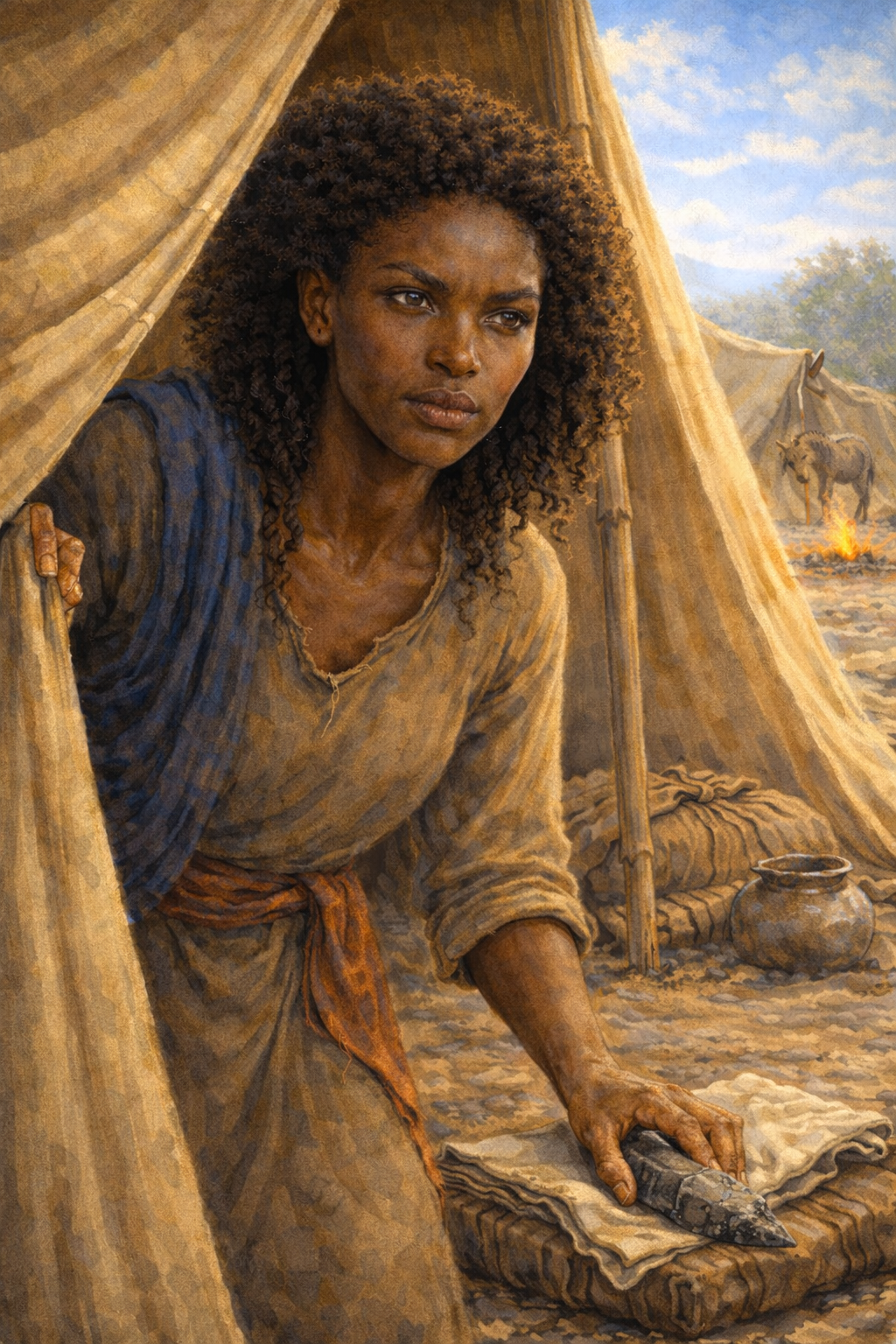
Zipporah acts without delay. “Then Zipporah took a flint and cut off her son’s foreskin and touched Moses’ feet with it, and said, ‘Surely you are a bridegroom of blood to me!’” (Exodus 4:25) The act halts the threat. “So he let him alone.” (Exodus 4:26) Zipporah recognizes what is required and carries it out herself. Her words name the cost of the moment. Moses had failed to carry out the covenant requirement, and Zipporah performs it herself – saving his life.
This moment places Zipporah at the center of Israel’s story, though she is not an Israelite. Raised in the household of a priest, she understands ritual obligation and acts decisively when Moses’ calling is at risk. Scripture does not soften the scene. It preserves her words and the sharpness of the action. Moses’ life — and the mission he is about to undertake — continues because Zipporah intervenes.
Moses goes on to confront Pharaoh, lead the Israelites out of Egypt, and become the central human leader during the wilderness years. He guides the people through a harsh and unsettled landscape, receives the law at Sinai, and carries the weight of leadership for a people learning how to live free. During this time, leadership is shaped not only by revelation, but also by counsel.
When Jethro comes to Moses in the wilderness, he watches Moses judge the people from morning until evening. Jethro speaks plainly, saying, “What you are doing is not good. You and the people with you will certainly wear yourselves out, for the thing is too heavy for you. You are not able to do it alone.” (Exodus 18:17–18) He advises Moses to share responsibility, instructing him to appoint capable leaders to help carry the load. “If you do this… you will be able to endure, and all this people also will go to their place in peace.” (Exodus 18:23)
Moses listens. He restructures leadership among the people, appointing others to judge everyday matters while he focuses on what only he can carry. In this moment, the priest of Midian helps shape how Israel is governed in the wilderness, showing that Israel’s leadership is formed not only through divine command, but also through wise, practical counsel.
Zipporah reappears briefly during this period. Jethro brings her and her sons to meet Moses in the wilderness. Scripture notes that Moses had sent her away earlier, though it does not explain when or why. (Exodus 18:2–6) Their reunion is recorded without commentary. Zipporah is present, but the narrative focus shifts to Moses’ public role and Jethro’s counsel.
After this, Zipporah does not appear again. Scripture records no further speech, no later actions, and no account of her death. What remains is what she did. Zipporah is a foreign woman living between cultures, married to a man called to confront empire and lead a people through years of uncertainty. When a crisis comes, she recognizes its seriousness and acts when delay would mean death.
Zipporah’s story is marked by interruption and consequence. She enters Moses’ life through conflict, preserves it through decisive action, and then recedes as the public story moves forward. Scripture does not explain her inner life, but it preserves the moment when her courage and clarity sustain the leader of Israel at a point of greatest vulnerability. Her obedience is not ceremonial or symbolic; it is immediate, costly, and life-saving — carried out when responsibility cannot be deferred and the future depends on action.
Zipporah: A Midianite Woman
Zipporah is neither Israelite nor Egyptian, and the biblical text is careful to preserve this distinction. She enters the Exodus story from outside its central struggle, shaped by Midian—a people and region east and southeast of the Sinai, extending into northwest Arabia and the southern Levant. The Midianites were semi-nomadic, active in trade, and culturally connected across regions rather than defined by empire or enslavement. Biblically, Midian descends from Abraham through Keturah, placing Zipporah within the wider Abrahamic world while remaining outside the covenantal line of Isaac and Jacob. She stands close to Israel’s story without belonging to it, carrying a parallel inheritance rather than a subordinate one.
Daughter of a Priest
Zipporah is the daughter of Jethro, also called Reuel, who is explicitly identified as a priest of Midian. This establishes the environment that formed her: a household structured around ritual knowledge, moral responsibility, and communal leadership. Jethro is portrayed as perceptive and authoritative, offering Moses practical wisdom rather than spiritual correction. Zipporah’s understanding of covenant, blood, and obligation comes from this priestly context, not from Israelite law. Her competence is learned, not inspired.
Neither Israelite nor Egyptian
Zipporah exists outside the two dominant powers of the Exodus narrative. She is not enslaved like Israel, nor aligned with Egyptian authority. Yet in Exodus 4:24–26, when Moses’ life is threatened because a covenantal obligation has been neglected, Zipporah alone recognizes the cause and acts. She does not pray, hesitate, or seek permission. She performs the required act herself, halting divine judgment through correct action. In that moment, her authority exceeds Moses’, not by position, but by understanding.
The Bible records a moment of tension around Moses’ marriage in Numbers 12, when Miriam and Aaron speak against Moses “because of the Cushite woman he had married.” The text does not quote the woman herself, nor does it explore her feelings or actions in that moment. Instead, it focuses on what this complaint reveals about authority, leadership, and discomfort with difference within the community. The criticism is raised by insiders—those with proximity to power—and it is framed not simply as a personal objection, but as part of a broader challenge to Moses’ leadership.
What matters most in the narrative is how God responds. The objection is not affirmed or explained away; it is interrupted. The text redirects attention away from the woman and onto the act of speaking against her and against Moses. Divine judgment falls on the speakers, not on the marriage, making clear that the problem lies in the critique itself rather than in the woman’s identity. In this way, the passage does not invite the reader to scrutinize the foreign wife, but to consider the dangers of using difference as a basis for undermining another’s calling or legitimacy.
This moment does not exist to define Zipporah—or the Cushite woman—by exclusion. Instead, it exposes a recurring human tendency: when leadership feels threatened, difference becomes an easy target. The biblical text resists that impulse by refusing to justify the complaint and by shifting moral weight back onto those who voiced it. The woman remains largely silent in the narrative, not because she is insignificant, but because the story is not ultimately about her belonging or unbelonging. It is about restraint, humility, and the limits of communal judgment.
Read this way, the passage is less about otherness as a flaw and more about how communities react when confronted with difference. The Bible does not resolve that tension by erasing distinction, nor does it ask the woman to defend herself. It simply makes clear that her presence is not the problem—and that speaking against her is.
Circumcision in the Hebrew Bible is not a medical detail or a private family custom; it is a covenantal sign that originates in the Abrahamic tradition. In Genesis 17, God establishes circumcision as the physical marker of the covenant between God and Abraham and his descendants. It is described as a binding obligation—one that must be carried out for every male child. The text is explicit: failure to uphold this sign is not a minor oversight but a breach serious enough to sever a person from the covenant community.
By the time of Moses, circumcision is therefore not a new or optional practice. It is an inherited responsibility tied to identity, obedience, and belonging. What makes Exodus 4:24–26 so striking is that Moses—the man chosen to confront Pharaoh and lead Israel—has failed to ensure that this foundational obligation has been fulfilled for his own son. The text does not explain why. It offers no justification, excuse, or divine warning. It simply presents the consequence: Moses’ life is suddenly threatened at a lodging place along the journey.
Zipporah’s response makes clear that she understands exactly what is at stake. She takes a flint—a traditional material associated with early ritual practice rather than later metal tools—and circumcises her son herself. This detail matters. The use of flint connects the act to ancient covenantal tradition, not innovation or improvisation. Her action is precise, knowledgeable, and effective. She does not appeal for mercy; she performs what is required.
The act saves Moses because it restores covenantal alignment at the moment it has been dangerously neglected. Moses cannot function as a representative of God’s covenant with Israel while standing in violation of that same covenant within his own household. Zipporah’s action resolves the contradiction. Once the obligation is fulfilled, the threat ceases immediately. The text states simply, “So he let him alone.” There is no further commentary because the ritual logic is complete.
Importantly, the passage does not frame circumcision here as violence or punishment, but as repair—a corrective act that reestablishes order where failure has created danger. Zipporah’s role underscores that covenantal responsibility is not abstract or symbolic; it is embodied, costly, and sometimes carried by those outside formal authority. Her action does not grant her status or recognition within Israel’s leadership, but it preserves the mission at its most vulnerable point.
In this moment, circumcision functions exactly as the biblical tradition intends it to: as a sign that binds life, obligation, and obedience together. Zipporah understands this. Moses, momentarily, does not. That is why her act matters—and why it saves him.
Who Would She Be Today?

Zipporah feels like a pastor’s kid. She would have grown up in a big, busy household where faith was woven into everyday life. She’d know the traditions, the language, the rhythms of belief. She’d be the kind of child who memorised key verses early on, not always fully understanding them at the time, but carrying them quietly until life made sense of them. Church would shape her, but it wouldn’t shield her from reality.
She would also be someone deeply aware of her background and race, especially once she married into a family where she was visibly different. Zipporah’s story already hints at the complexity of being part of a multicultural family, and today that would likely include navigating awkward in-laws, unspoken assumptions, micro-aggressions that don’t always come from malice but heavily felt. She would also feel the pressure of having a life with someone that is constantly away, she would know that her partners calling is larger than their family, and something that isn’t so easy to explain to those looking in. She would learn, sometimes painfully, when to speak and when to let things pass.
That confidence wouldn’t come from nowhere. She’d have a father, siblings, and a wider family who advocated for her, affirmed her, and gave her a strong sense of identity long before she ever had to defend it. So when she steps into a marriage shaped by a huge calling—one that pulls her into public scrutiny and constant movement—she isn’t naïve or easily shaken. Scripture shows her as someone who acts decisively, without waiting for permission, especially when her family’s wellbeing is at stake. Today, she’d be grounded, emotionally intelligent, and resilient. She’d rise above the noise not by pretending it doesn’t exist, but by knowing her worth, trusting her instincts, and doing what she believes is right—even when no one is watching, and even when it costs her something.
Where Zipporah Appears in Scripture
Exodus 2:16–22
Zipporah is introduced as one of the seven daughters of a Midianite priest. Moses meets her at a well, defends her and her sisters, is welcomed into their household, and later marries her. She gives birth to a son, Gershom. Zipporah does not speak in this passage.
Exodus 4:20
Zipporah is referenced as Moses’ wife when Moses takes her and their sons and begins the journey back to Egypt. She does not speak or act directly in this verse.
Exodus 4:24–26
Zipporah acts decisively at a lodging place on the journey. She circumcises her son with a flint and touches Moses’ feet with the foreskin. She speaks one line: “Surely you are a bridegroom of blood to me.” The threat to Moses’ life ends immediately after her action.
Exodus 18:1–6
Zipporah is referenced when Moses’ father-in-law brings her and her two sons back to Moses in the wilderness. The text implies she had been staying apart from Moses. Zipporah does not speak or act in this passage.
Legacy
Within Christian tradition, Zipporah has often occupied an uneasy place—recognized as important, yet rarely explored in depth. Early Christian writers tended to pass quickly over her story, focusing instead on Moses as prophet and lawgiver. When Zipporah was mentioned, it was usually in relation to the difficult passage in Exodus 4, where her act of circumcising her son raised discomfort and theological tension. Some interpretations minimized her role, portraying her as merely reacting in fear or acting reluctantly, while others treated the episode as obscure or troubling and chose not to linger on it at all.
At times, her story has been misunderstood or flattened. Zipporah has occasionally been described as resistant to Israelite practices or as spiritually misaligned, despite the text offering no such judgment. These readings often say more about later assumptions—particularly discomfort with a woman performing a covenantal act—than about the biblical narrative itself. In some traditions, her foreign identity was emphasized in ways that reinforced distance rather than understanding, turning her into a marginal figure rather than recognizing her decisive role.
At the same time, Christian readers have also found in Zipporah a quiet strength that resists easy categorization. She has been honored as a woman whose knowledge and action preserved God’s mission at a critical moment, even when the central male figure faltered. Her story has been used, carefully and sometimes cautiously, to reflect on obedience, responsibility, and the seriousness of covenant. For some, she has become an example of faithful action carried out without recognition or reward.
In recent years, many Christians have returned to the biblical text with renewed attention, reading Zipporah more closely and with greater humility. Rather than filling in gaps with speculation, modern readers are increasingly allowing the restraint of Scripture to stand, acknowledging both what is said and what is left unsaid. This re-examination has opened space for conversations about gender, authority, cultural difference, and the ways God’s purposes are sometimes upheld by unexpected people. Zipporah’s legacy, though brief in Scripture, continues to shape Christian reflection by reminding readers that faithfulness is not always loud, visible, or celebrated—and that some of the most consequential acts in the biblical story are carried out quietly, by those the text does not center but does not dismiss.
Reply