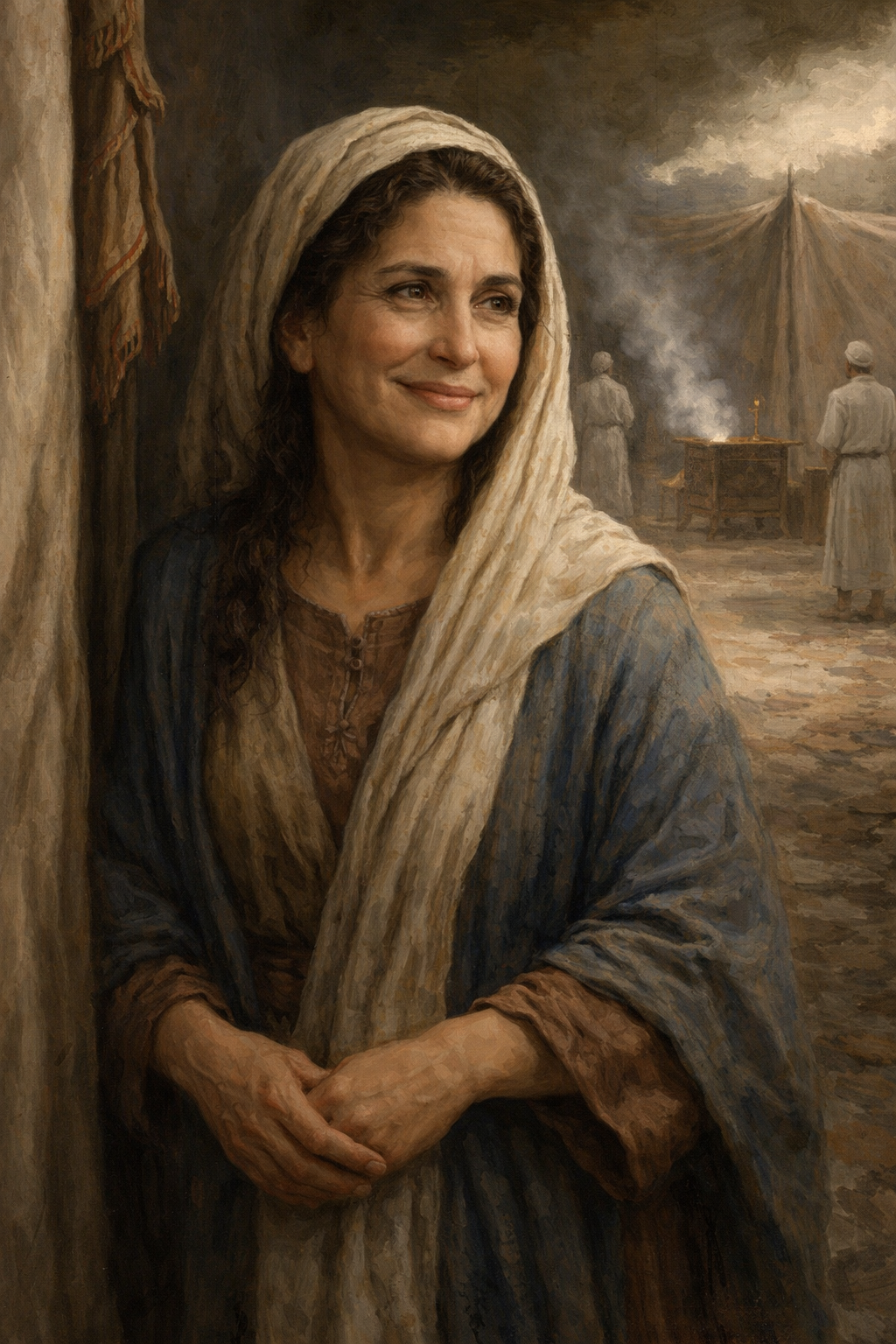
Elisheba’s Story
Elisheba appears in Scripture during the early years of Israel’s life after leaving Egypt. The people are no longer slaves, but they are not settled either. They are living in the wilderness, moving from place to place, learning how to live as a nation shaped by covenant rather than oppression. This is the moment when Israel’s systems of worship and leadership are being established.
Elisheba is named as the wife of Aaron, the brother of Moses, the leader who brought Israel out of Egypt. Scripture introduces her plainly: “Aaron took Elisheba, daughter of Amminadab, sister of Nahshon, as his wife.” (Exodus 6:23) Her name appears as the priesthood is being formally defined.
Elisheba comes from the tribe of Judah. Her brother, Nahshon, is named elsewhere as a recognised leader during Israel’s wilderness journey. This places Elisheba at the meeting point of two central tribes: Judah, associated with leadership, and Levi, associated with priesthood. Through her marriage, she stands close to the heart of Israel’s emerging structure.
Elisheba and Aaron have four sons: Nadab, Abihu, Eleazar, and Ithamar. (Exodus 6:23) Their children grow up inside the priestly system from the beginning. As Aaron is appointed high priest, his sons are ordained to serve with him. Elisheba’s household becomes the first priestly family in Israel’s history.
Soon after the priesthood begins, tragedy strikes. While the people are still gathered at Mount Sinai, Nadab and Abihu offer incense in a way God has not commanded. Scripture records the moment starkly: “Fire came out from before the LORD and consumed them, and they died before the LORD.” (Leviticus 10:2) The loss is sudden and public. Two sons die at the very moment their priestly service begins.
Moses speaks to Aaron, interpreting the event as a matter of holiness and responsibility. Aaron says nothing. “And Aaron held his peace.” (Leviticus 10:3) Aaron and his remaining sons are commanded not to mourn publicly, because their priestly duties must continue. (Leviticus 10:6–7) The narrative does not pause to describe Elisheba’s grief, but the cost is unmistakable. A mother loses two sons, and the system moves forward.
Life continues. Elisheba’s remaining sons, Eleazar and Ithamar, continue serving as priests. Through them, the priestly line endures. Elisheba remains the matriarch of the priestly household, carrying both continuity and loss within the same family.
Scripture does not record Elisheba’s words, but it records her place. She stands beside the high priest at the founding of Israel’s worship, raises sons within sacred responsibility, and lives through devastating consequence without public voice. Her story unfolds in tents, at the foot of a mountain, within a community learning what holiness costs.
Elisheba’s life reminds us that the formation of Israel’s priesthood was not only ceremonial — it was costly. Behind the robes, rituals, and leadership stood a woman whose family bore both honor and grief. Her legacy continues through the priesthood that follows, shaped by obedience, failure, consequence, and endurance — all held within the same unfolding story.
The tribe of Judah comes from Judah, the fourth son of Jacob and Leah. From early on, Judah is associated with leadership among the tribes of Israel. When Jacob blesses his sons near the end of his life, he speaks directly about Judah’s future, saying that rulership will come from his line: “The scepter shall not depart from Judah.” (Genesis 49:10)
During the wilderness period, Judah emerges as a leading tribe. Its representatives are named first in census lists, and the tribe often sets out at the front when Israel moves camp (Numbers 2:3). This establishes Judah as a tribe associated with guidance, visibility, and responsibility within the community.
Over time, Judah’s significance deepens. Israel’s kings, beginning with David, come from this tribe, and the royal line continues through Judah. In Christian understanding, this lineage ultimately connects to Jesus. When Elisheba is identified as being from Judah, Scripture places her within a family line marked by leadership and future promise, even though her own life unfolds within the priestly household of Levi.
This note helps readers see that Judah is not just a family name, but a thread of leadership and continuity running through Israel’s story — one that intersects with Elisheba’s life in a meaningful way.
Nadab and Abihu, the sons of Aaron and Elisheba, die shortly after the priesthood is established. Scripture states that they “offered unauthorized fire before the LORD, which he had not commanded them.” (Leviticus 10:1) The issue is not sacrifice itself, but that they act outside the specific instructions God had given for worship. At this stage in Israel’s history, the priesthood is new, and the boundaries around holiness are being clearly defined.
The response is immediate: “Fire came out from before the LORD and consumed them, and they died before the LORD.” (Leviticus 10:2) Moses explains the meaning of the moment to Aaron, saying, “Among those who are near me I will be sanctified, and before all the people I will be glorified.” (Leviticus 10:3) The consequence reflects the seriousness of proximity to God within the priestly role. Nadab and Abihu are not punished for approaching God, but for approaching Him on their own terms while carrying sacred responsibility.
This event reveals something important about God’s relationship with Israel at this moment. God is forming a people who are learning how to live near His presence. Worship is not treated casually, because it shapes how the community understands God’s holiness and trustworthiness. The priesthood carries privilege, but also heightened accountability. The severity of the consequence marks the beginning of Israel’s worship life, setting clear boundaries at its foundation.
For Elisheba, this means bearing a deeply personal loss within a public religious framework that does not pause for mourning. The system continues, but the cost is real. The story does not suggest that God is distant or cruel, but that closeness to God carries weight. Holiness is not arbitrary; it is protective, shaping how a newly freed people learns to live with God in their midst.
Who Would She Be tODAY?

I imagine Elisheba as someone you’d recognise as the wife of a very prominent pastor or leader. You’d know her name, you might have heard her speak, maybe even watched her share a message once or twice, in person or online. She has a huge following. From the outside, she’s steady and present — the person who shows up, smiles, listens, and holds space for others without drawing attention to herself.
Behind that public life sits a private weight. A deep loss in her household that is never spoken about from the stage, never explained, but quietly known. Everyone senses it, even if no one names it. And still, she keeps going. She supports her family, holds things together, stays faithful to the role she carries, even when it costs her something. The grief doesn’t disappear — it just becomes something she carries with dignity.
Elisheba feels like someone who is loyal to the end, deeply committed, and trusted by many. But the real version of her — the full weight of what she’s lived through — is only visible within her home. Her story reminds us that some of the strongest people in faith communities are the ones who keep showing up for others while carrying loss that never makes it into a sermon.
Where Elisheba Appears in Scripture
Exodus 6:23
Elisheba is named as the wife of Aaron; she is identified as the daughter of Amminadab and the sister of Nahshon. Her sons Nadab, Abihu, Eleazar, and Ithamar are listed.
Leviticus 10:1–7
Elisheba is not named directly, but she is directly involved as the mother of Nadab and Abihu, who die after offering unauthorized fire before the LORD. Aaron and his remaining sons are instructed not to mourn publicly.
Numbers 3:2–4
Elisheba’s sons are listed again in the context of priestly lineage; Nadab and Abihu’s deaths are referenced, and Eleazar and Ithamar continue serving as priests.
Numbers 26:59
Elisheba is referenced indirectly through her sons as part of the priestly genealogy.
Legacy
Within Christian reflection, Elisheba is often mentioned only in passing, usually as part of Aaron’s family or within genealogies of the priesthood. Her presence is acknowledged, but rarely explored. This has meant that her story is frequently absorbed into the narrative of male leadership, even though her life is bound up with the formation of Israel’s worship and priestly identity.
Christian teaching has tended to focus on the dramatic elements surrounding her household — particularly the deaths of Nadab and Abihu — while leaving Elisheba herself unnamed in discussion. At times, her silence in Scripture has been read as absence, rather than as a reflection of how women’s lives were recorded in ancient texts. The cost borne by a mother within a system that demanded public composure has often gone unspoken.
More careful readings are beginning to recognise that Elisheba stands at the heart of Israel’s priestly beginnings. She is not a background figure, but the matriarch of the priesthood, whose family carries both sacred responsibility and devastating consequence. Her story invites reflection on the hidden costs of spiritual leadership and the way holiness shapes entire households, not just public figures.
Today, Elisheba’s legacy is increasingly read with greater attentiveness to what Scripture preserves and what it leaves unsaid. Her life challenges the Church to consider whose stories are remembered, how grief is carried within religious systems, and how faith communities honour those who bear responsibility without public voice. Elisheba continues to shape conversations about leadership, sacrifice, and the unseen weight carried by those closest to the work of God.
Reply