Miriam’s sTORY
Miriam is born into a dangerous time. She is a Hebrew girl living in Egypt generations after Jacob’s family settled there. The Israelites have grown into a large population, and the ruling Pharaoh views them as a threat. In response, he orders that every Hebrew boy be killed at birth. Miriam grows up in a household shaped by this fear. Her parents are Jochebed and Amram, and she has two younger brothers, Aaron and Moses.
Miriam’s first appearance in Scripture comes when her baby brother Moses is in immediate danger. Jochebed hides him for three months, but when that becomes impossible, she places him in a waterproof basket among the reeds of the Nile. Miriam stays nearby. “And his sister stood at a distance to know what would be done to him.” (Exodus 2:4) She is not passive. She is watching carefully, ready to act.
When Pharaoh’s daughter comes down to bathe and finds the child, she recognizes that he is a Hebrew baby and feels compassion. At that moment, Miriam steps forward and speaks. “Shall I go and call you a nurse from the Hebrew women to nurse the child for you?” (Exodus 2:7) Pharaoh’s daughter agrees, and Miriam brings her own mother. Through Miriam’s timing and courage, Moses remains with his family during his earliest years. This moment shapes the survival of the one who will later lead Israel out of slavery.
Years pass. Moses grows up, eventually confronting Pharaoh and leading the Israelites out of Egypt after a series of devastating plagues. The people leave in haste and are pursued by the Egyptian army. When they cross the Red Sea and the pursuing army is destroyed, the Israelites find themselves free but standing at the edge of the wilderness — a vast, harsh landscape with no clear future.
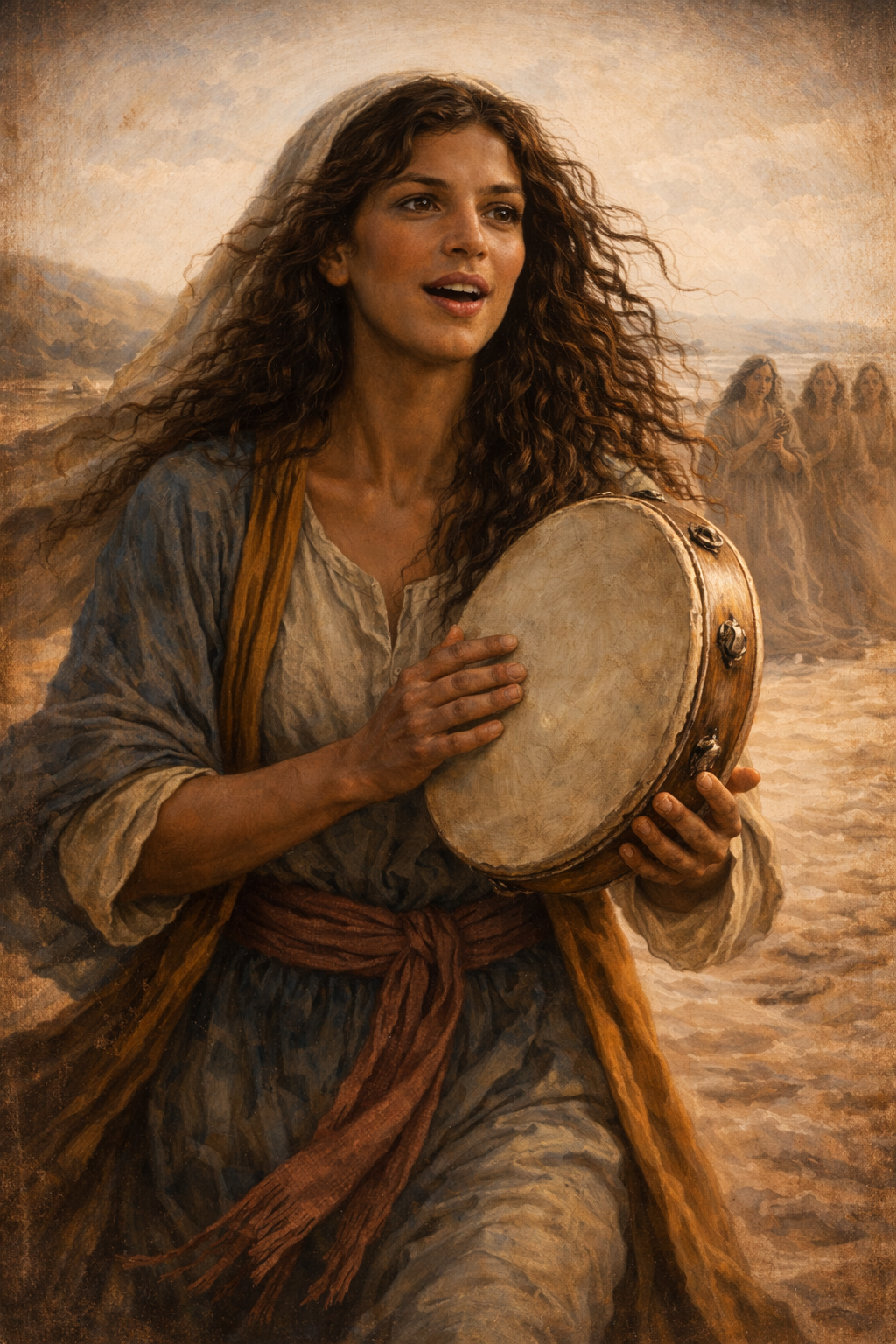
It is here that Miriam appears again, now as a leader. Scripture names her directly: “Then Miriam the prophetess, the sister of Aaron, took a tambourine in her hand.” (Exodus 15:20) She leads the women in song and movement, answering the victory song with her own words: “Sing to the LORD, for he has triumphed gloriously; the horse and his rider he has thrown into the sea.” (Exodus 15:21) Miriam gives voice to celebration at the very beginning of Israel’s life as a free people.
The wilderness years that follow are long and difficult. Israel lives between promise and fulfillment, moving from place to place, dependent on daily provision. Leadership during this time is demanding and often contested. Moses serves as the primary leader and lawgiver. Aaron functions as priest. Miriam is counted alongside them. Later Scripture recalls God’s words to Israel: “I sent before you Moses, Aaron, and Miriam.” (Micah 6:4) Miriam is remembered as one of the leaders who guided the people through this uncertain period.
During the wilderness journey, tension arises. Miriam and Aaron speak against Moses, first referring to his marriage — “because of the Cushite woman whom he had married” — and then questioning his authority, asking whether God speaks only through him. (Numbers 12:1–2) The challenge is not a single comment, but a layered one, involving both Moses’ leadership and his relationship with Zipporah. God responds directly, affirming Moses’ unique role. Miriam is struck with leprosy and sent outside the camp for seven days. The consequence is public and humbling. Aaron pleads for her, and Moses cries out, “O God, please heal her.” (Numbers 12:13)
The people do not move forward during her exclusion. “The people did not set out on the march till Miriam was brought in again.” (Numbers 12:15) Her absence pauses the entire community. After the period ends, Miriam is restored and returns to the camp. Scripture does not record further public leadership, but she remains part of Israel’s journey.
Miriam dies in the wilderness at Kadesh. “Miriam died there and was buried there.” (Numbers 20:1) Her death marks a significant moment in Israel’s story, occurring shortly before major transitions for the people.
Miriam’s life spans Israel’s history from oppression in Egypt to freedom in the wilderness. She acts as a watchful sister, a courageous speaker, a worship leader, a recognized guide, and a woman who experiences correction and restoration. Scripture presents her fully — not idealized, not erased. She is remembered as someone whose presence mattered enough that the people could not move on without her.
Miriam is introduced in Scripture as the sister of Moses, the central human leader of the Exodus — the one who confronts Pharaoh, receives the law, and guides Israel through the wilderness. Moses’ role is singular and foundational. But Scripture is careful not to frame Miriam as secondary or incidental to his story.
Miriam appears before Moses ever speaks as a leader. She acts to protect him as a child, later leads the women of Israel in worship as a prophetess, and is explicitly named by God alongside Moses and Aaron as one of the leaders sent before the people: “I sent before you Moses, Aaron, and Miriam.” (Micah 6:4) This is not honorary language. It places Miriam within Israel’s leadership structure during the wilderness years.
Scripture allows Moses’ authority to stand without diminishing Miriam’s role. She does not replace him, but neither is she absorbed into his shadow. Her leadership is public, named, and remembered. Miriam’s story shows that Israel’s deliverance and survival were carried by more than one voice — and that women were present, visible, and accountable within that leadership from the very beginning.
The wilderness was not a brief journey or a symbolic place. It was where the Israelites lived for years after leaving Egypt, moving between camps with no permanent homes, no farmland, and no clear end in sight. Life in the wilderness meant daily dependence on food and water provided day by day, constant movement, and shared strain. Families lived close together, carrying both hope and frustration as they waited for what had been promised.
For Miriam, the wilderness was where leadership was tested. It was where celebration gave way to endurance, where faith was lived out under pressure, and where conflict emerged alongside community. Her life unfolded not in stability, but in a place defined by uncertainty, proximity, and survival — a setting that shaped both her influence and the consequences she faced.
The Law of Moses, also called the Mosaic Law, refers to the body of laws God gave to Israel through Moses after the Exodus from Egypt. It includes the Ten Commandments as its foundation (Exodus 20), along with wider instructions covering worship, sacrifice, justice, community life, care for the vulnerable, festivals, and daily conduct. These laws are recorded primarily in Exodus, Leviticus, Numbers, and Deuteronomy and form the covenant framework for Israel’s life with God.
Moses’ role as lawgiver gives him a unique position of authority within Israel. At the same time, Scripture shows that leadership during this period was shared. Miriam, named alongside Moses and Aaron as one of the leaders sent before the people (Micah 6:4), lived and led within the same covenant framework shaped by this law. Her story unfolds in the context of the Mosaic Law.
Resistance to women in leadership appears far more strongly in later interpretation than in the biblical text itself. Scripture openly names women such as Miriam (Micah 6:4), Deborah (Judges 4–5), and Huldah (2 Kings 22) as leaders whose authority is recognised and acted upon. None of these women are corrected simply for leading. The tension begins later, when interpreters prioritise certain passages about order and household structure and apply them broadly, while treating women leaders as exceptions rather than part of the pattern.
The texts most often elevated in these discussions include 1 Corinthians 14:34–35 (“women should remain silent in the churches”), 1 Timothy 2:11–12 (“I do not permit a woman to teach or to exercise authority over a man”), and household codes such as Ephesians 5:22–24 and Colossians 3:18, which address wives and family order. Over time, these passages were read as universal restrictions, often detached from their local context, while narrative texts showing women leading were minimised or explained away. Deborah was described as leading only because men failed, though the text never says this. Miriam’s correction in Numbers 12 was emphasised more than her leadership named by God. Huldah’s prophetic authority was acknowledged historically but rarely taught.
When the New Testament is read as a whole, however, women continue to appear in positions of influence and leadership. Priscilla teaches alongside her husband and helps instruct Apollos (Acts 18:26). Phoebe is named as a deacon and trusted carrier of Paul’s letter to the Romans (Romans 16:1–2). Junia is described as “outstanding among the apostles” (Romans 16:7). These examples sit alongside the household texts, not in opposition to Scripture, but in tension that requires careful reading rather than selective emphasis.
What emerges is not a Bible that resists women leaders, but a tradition that grew increasingly uncomfortable with them. When Scripture is read attentively and in full, women’s leadership appears not as disorderly or accidental, but as part of how God works through people — in both Testaments — especially in moments requiring wisdom, courage, and faithfulness.
Who Would She Be Today?

I imagine being invited to a dance class Miriam runs in an old community hall — the kind of place you’d normally walk past without noticing. But once she’s there, the room feels different. Music on, people laughing, bodies moving, energy shifting. She has a way of bringing life into tired spaces. You don’t go just to dance — you go because you feel seen, because something about her enthusiasm reminds you that joy still has a place here, despite the chaos going on daily.
Miriam would have brothers carrying enormous responsibility, leading people through something long, difficult, and draining, in a place that still feels broken even as everyone hopes for better. She stands alongside them, not behind them. And because of that closeness, she becomes a steady presence for women — familiar, trusted, and grounded. She meets people where they are. She uses what’s available. She understands the strain of leadership that doesn’t end quickly.
What stays with me about Miriam is how human she is. She carries a strong calling over years, from a young girl, she has the urge to take care of her brothers, and she is smart and quick thinking enough to understand complex systems, and when to speak, and how to present. She isn’t just relevant for moments, but she shapes the environment around her the best way she can. She speaks up when things feel unfair. She complains. She faces consequences. And she keeps going. Miriam shows us that leadership isn’t about being untouchable — it’s about staying engaged, staying honest, and choosing to remain part of the work even when it costs you something. That’s the kind of leader you remember long after the music stops.
Where Miriam Appears in Scripture
Exodus 2:4
Miriam watches from a distance as her infant brother is placed among the reeds of the Nile.
Exodus 2:7–8
Miriam speaks to Pharaoh’s daughter, offers to find a Hebrew nurse, and brings her mother to care for the child.
Exodus 15:20–21
Miriam is named as a prophetess; she leads the women of Israel with a tambourine and sings praise after the crossing of the Red Sea. Miriam speaks.
Numbers 12:1–15
Miriam, with Aaron, speaks against Moses’ authority; she is struck with leprosy, shut outside the camp for seven days, prayed for by Moses, and later restored.
Numbers 20:1
Miriam dies and is buried at Kadesh in the wilderness of Zin.
Numbers 26:59
Miriam is named in a genealogy as the daughter of Amram and Jochebed, sister of Aaron and Moses.
Deuteronomy 24:9
Miriam is referenced indirectly as a warning example regarding what happened to her after speaking against Moses.
Micah 6:4
God names Miriam alongside Moses and Aaron as one of the leaders sent before Israel.
Legacy
Within Christian tradition, Miriam has been honoured as a significant but sometimes underexplored leader. She is widely recognised as a prophetess and worship leader, especially for her role after the crossing of the Red Sea, yet her leadership has often been framed as secondary to that of Moses and Aaron. In many teachings, she appears briefly and then fades, despite Scripture naming her explicitly as one of the leaders God sent before Israel (Micah 6:4).
At times, Christian interpretation has focused heavily on Miriam’s failure in Numbers 12, treating her challenge to Moses as the defining moment of her story. This has sometimes overshadowed the breadth of her life — her early courage, her public leadership, and her long presence among the people. Read narrowly, her punishment has been used as a warning against questioning authority, without equal attention given to her restoration or to the fact that the community halted its journey until she was brought back.
More careful readings in recent years have begun to hold Miriam’s story together more honestly. Scholars and teachers are paying closer attention to the fact that she is named, speaks, leads, is corrected, and restored — a full arc rarely granted to women in ancient texts. Her story shows that leadership in Israel included accountability as well as authority, and that correction did not erase calling.
Today, Miriam’s legacy continues to shape Christian conversations about women in leadership, prophetic voice, and shared responsibility within God’s people. She stands as a reminder that faithfulness is not the absence of failure, but the willingness to remain part of the story after it. Miriam is neither idealised nor erased in Scripture, and that balanced portrayal continues to invite the Church to read her life — and the lives of other women — with greater care, humility, and respect.
Reply