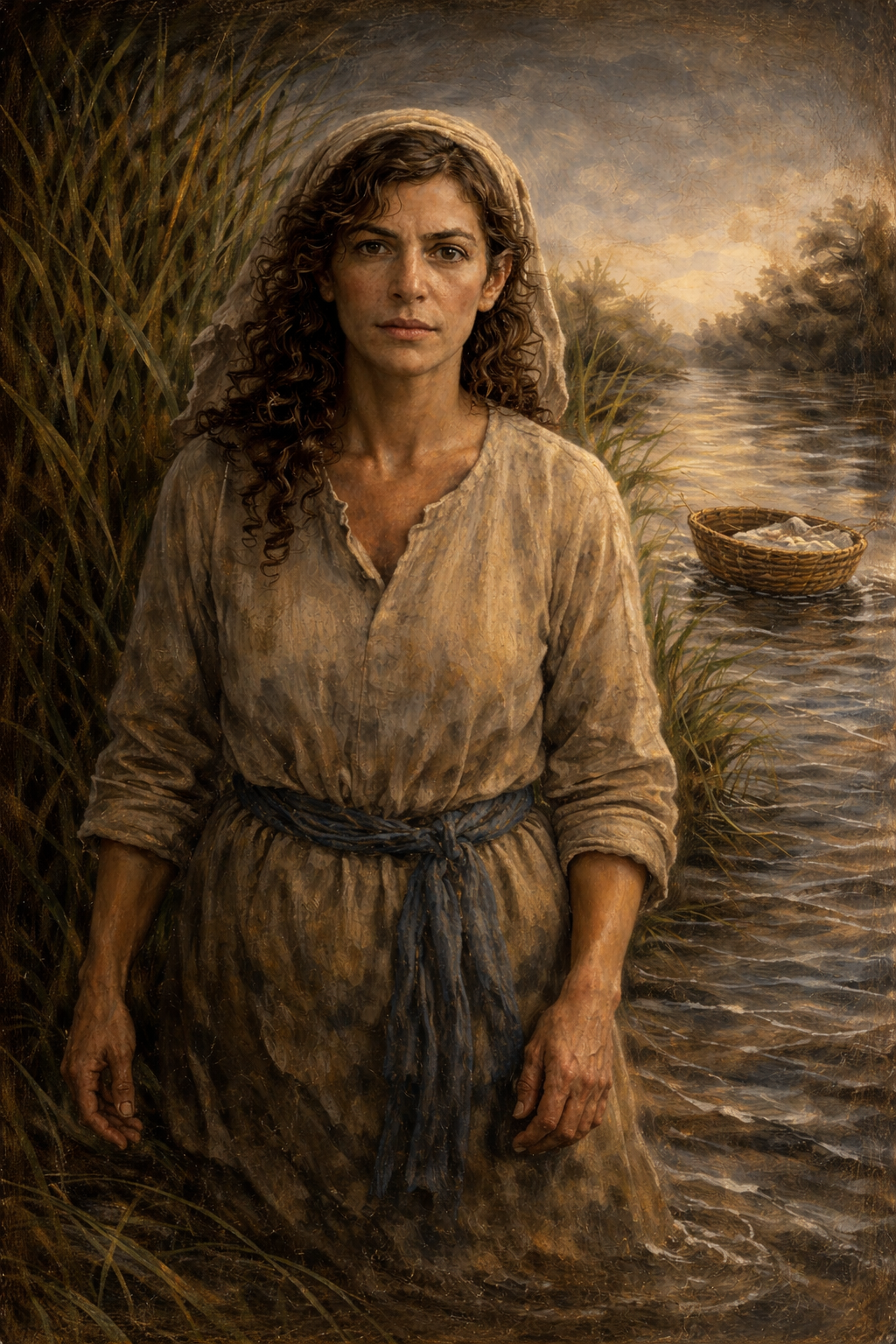
Jochebed’S Story
Jochebed is introduced as a woman already living under threat. She is a Hebrew woman from the tribe of Levi, married to Amram, and living in Egypt at a time when Israel’s growth has become a political problem. Pharaoh has ordered that every Hebrew boy be thrown into the Nile. This is the world Jochebed gives birth into — one where motherhood itself carries risk.
Scripture records her action first, not her fear. “A man from the house of Levi went and took as his wife a Levite woman. The woman conceived and bore a son, and when she saw that he was a fine child, she hid him three months.” (Exodus 2:1–2) Jochebed sees her son and acts. Hiding him is not passive resistance; it requires constant vigilance, silence, and risk. Every cry threatens exposure. Every day extends the danger.
When she can no longer hide him, Jochebed makes a second decision. “She took for him a basket made of bulrushes and daubed it with bitumen and pitch. She put the child in it and placed it among the reeds by the river bank.” (Exodus 2:3) This is not abandonment. It is preparation. She builds protection into the basket and places her child deliberately, not randomly, along the Nile — the very river meant to destroy him.
Jochebed does not act alone. Her daughter, Miriam, stands at a distance to watch what will happen. (Exodus 2:4) The family works together, each taking a role. Jochebed releases her son into danger, and Miriam stays close enough to respond.
The basket is found by Pharaoh’s daughter, who opens it and sees the child crying. Scripture says, “She took pity on him and said, ‘This is one of the Hebrews’ children.” (Exodus 2:6) Miriam steps forward and offers a solution: “Shall I go and call you a nurse from the Hebrew women to nurse the child for you?” Pharaoh’s daughter agrees. Miriam brings the child’s own mother.
Jochebed is brought back into her son’s life openly. Pharaoh’s daughter says to her, “Take this child away and nurse him for me, and I will give you your wages.” (Exodus 2:9) Jochebed takes her son and nurses him, this time with protection rather than secrecy. The woman who had to hide her child is now paid to raise him. When the child grows older, Jochebed brings him to Pharaoh’s daughter, and he becomes her son. She names him Moses, saying, “Because I drew him out of the water.” (Exodus 2:10)
Jochebed’s story does not end there. Later Scripture names her again, identifying her clearly: “The name of Amram’s wife was Jochebed… and she bore to Amram Aaron and Moses, and Miriam their sister.” (Numbers 26:59) She is the mother of Aaron, who will become Israel’s first high priest, and Miriam, who will lead the women of Israel in worship. Jochebed raises three children who will each shape Israel’s future in different ways.
Jochebed speaks no recorded words in Scripture, but her actions speak consistently. She protects life under threat, releases control when necessary, and reclaims responsibility when opportunity opens. She works within danger, within family, and within the limits placed on her, yet her decisions carry lasting consequence. The deliverer of Israel survives because his mother acts with courage, care, and clarity.
Jochebed’s life shows that obedience and bravery often look like sustained responsibility rather than dramatic display. She does not overthrow Pharaoh. She outlasts his decree. Through her choices, what was meant for death becomes the beginning of deliverance, and her story continues through the children she raised and the future they helped shape.
Who Would She Be Today?

Jochebed always makes me think of women who’ve had to let go of their children because staying just wasn’t safe. Especially in times of war or crisis, when there isn’t a good option — just the least dangerous one. I imagine her as a mother who makes that kind of impossible choice, the sort you never stop thinking about. Like putting a child on a boat to another country and hoping someone kind finds them. You don’t do it because you want to. You do it because keeping them close could cost them their life.
What really gets me about Jochebed is that when she does get her child back, it’s not in the way you’d hope. She’s reunited, but she has to hand him over again, knowing he’ll be raised in a world she can’t control. And she accepts that. She nurses him, loves him, and then steps back, choosing his survival over her role as his mother. I imagine her always wondering how he’s doing, who he’s becoming, and whether he remembers her. Jochebed feels like the kind of woman who carries that quietly for the rest of her life — not because it was easy, but because sometimes love looks like letting go when there’s no safe way to hold on.
Where Jochebed Appears in Scripture
Exodus 2:1–3
Jochebed conceives and gives birth to a son; she hides him for three months and then places him in a basket among the reeds of the Nile.
Exodus 2:7–9
Jochebed is indirectly involved when her daughter arranges for her to nurse her own child; Pharaoh’s daughter instructs her to take the child and nurse him for wages.
Exodus 2:10
Jochebed brings the child back after he grows older; he is adopted by Pharaoh’s daughter and named Moses. Jochebed does not speak.
Numbers 26:59
Jochebed is named explicitly as the wife of Amram and the mother of Aaron, Moses, and their sister Miriam.
Legacy
Within Christian tradition, Jochebed has long been honoured as a model of courageous motherhood and faithful action under threat. She is often remembered for her ingenuity and bravery in protecting Moses, especially her decision to hide him and then place him in the Nile with care rather than surrender him to Pharaoh’s decree. Her story has been used frequently in teaching about trust in God, parental courage, and the preservation of life in the face of injustice.
At times, Christian interpretation has focused so strongly on Jochebed’s faith that the cost of her actions can be overlooked. Her story is sometimes presented as a simple act of trust, without fully acknowledging the fear, grief, and risk involved in releasing her child into danger. Scripture does not describe her emotions, but it does show sustained responsibility and difficult decision-making rather than a single heroic moment. Reducing her story to symbolism alone can flatten the lived reality of her choices.
More recent readings have begun to engage Jochebed as a woman whose faith is expressed through careful, practical action. Scholars and teachers note that her courage works in coordination with others — her husband Amram, her daughter Miriam, and even Pharaoh’s daughter — highlighting how deliverance begins through a network of women acting decisively within their circumstances. Her legacy continues to shape Christian conversations about moral courage, resistance to unjust authority, and the quiet faith that preserves life long before deliverance becomes visible.
Reply