
hAGAR’S sTORY
Hagar enters the biblical story already in a vulnerable position. Scripture first names her in Genesis 16 as “Hagar the Egyptian”, identifying both her name and her origin. She is a foreign woman living in the household of Abram and Sarai in the land of Canaan, far from her place of birth. She is not introduced through choice or calling, but through service. She belongs to Sarai’s household as a servant, and her life is shaped by decisions made above her.
Years have passed since God promised Abram descendants, and Sarai remains without a child. Sarai speaks directly to Abram, naming her grief and frustration:
“The Lord has prevented me from bearing children” (Genesis 16:2).
She proposes a solution that was socially accepted at the time — that Hagar will bear a child on her behalf. Abram agrees, and Hagar is given to him.
Hagar conceives.
Scripture does not romanticise what follows. It tells us plainly that once Hagar knows she is pregnant, the power dynamic in the household shifts:
“When she saw that she had conceived, she looked with contempt on her mistress” (Genesis 16:4).
The text does not explain her inner thoughts, but it shows a change. Pregnancy gives Hagar status she did not previously have — and that change creates tension.
Sarai responds sharply. She confronts Abram and says,
“May the wrong done to me be on you!” (Genesis 16:5).
Abram deflects responsibility, telling Sarai,
“Behold, your servant is in your power; do to her as you please.”
What follows is severe. Sarai mistreats Hagar, and the pressure becomes unbearable.
“Then Sarai dealt harshly with her, and she fled from her.” (Genesis 16:6)
Hagar runs — pregnant, alone, and without protection.
She is found in the wilderness, by a spring on the road to Shur, a route that leads back toward Egypt (Genesis 16:7). For the first time in the narrative, someone addresses Hagar directly. The angel of the Lord calls her by name and position:
“Hagar, servant of Sarai, where have you come from and where are you going?”
Hagar answers honestly:
“I am fleeing from my mistress Sarai.” (Genesis 16:8)
She is told to return — a hard instruction — but she is also given something no one else has given her so far: a promise. The angel says,
“I will surely multiply your offspring so that they cannot be numbered for multitude.” (Genesis 16:10)
Her son is named before he is born:
“You shall call his name Ishmael, because the Lord has listened to your affliction.” (Genesis 16:11)
This moment changes everything. Hagar responds by naming God — the only person in Scripture to do so in this way. She says,
“You are a God of seeing,”
and adds,
“Truly here I have seen him who looks after me.” (Genesis 16:13)
Hagar returns and gives birth to Ishmael. Abram names the child, as instructed (Genesis 16:15). Life continues, but the household remains fragile.
Years later, after Isaac is born to Sarah, tension surfaces again. At a celebration marking Isaac’s growth, Sarah sees Ishmael and speaks decisively to Abraham:
“Cast out this slave woman with her son, for the son of this slave woman shall not be heir with my son Isaac.” (Genesis 21:10)
The decision grieves Abraham deeply, but God instructs him to listen to Sarah and reassures him:
“I will make a nation of the son of the slave woman also, because he is your offspring.” (Genesis 21:13)
Hagar is sent away with her child and limited supplies. When the water runs out in the wilderness of Beersheba, she places Ishmael at a distance and breaks down. Scripture names her grief without restraint:
“She lifted up her voice and wept.” (Genesis 21:16)
God hears again.
“God heard the voice of the boy.” (Genesis 21:17)
Hagar is called from heaven and told not to fear. Her eyes are opened, and she sees a well. Ishmael survives.
Scripture closes Hagar’s story with continuation. Ishmael grows up in the wilderness. He becomes an archer. Hagar finds him a wife from Egypt — her homeland — and his life extends into a future God promised from the beginning (Genesis 21:20–21).
Hagar’s story is one of displacement, endurance, and divine recognition. She is used, mistreated, sent away — and seen. She speaks honestly. She names God. She survives loss and raises a son under promise. Scripture does not erase her suffering, but it does not abandon her to it either.
It helps to pause here and understand what was actually happening between Sarah and Hagar, because it wasn’t a personal arrangement dreamed up on the spot — it was a recognised household practice of the time.
Sarah is clear about her motivation when she speaks: “The Lord has prevented me from bearing children” (Genesis 16:2). In response, she gives Hagar to Abraham so that a child might be born within the household. In that cultural setting, the child would legally belong to Sarah, not to Hagar. Hagar’s body carries the pregnancy, but Sarah’s status defines the outcome.
What’s important — and often overlooked — is that Hagar does not initiate this arrangement and does not consent in the way we would expect today. She is a servant in the household, and decisions about her body and future are made for her. Scripture does not justify this, but it does record it plainly.
Once Hagar becomes pregnant, the power balance shifts. Pregnancy gives her visibility and value she did not previously have, and that change destabilises the household. Sarah feels threatened. Abraham steps back rather than intervening. The arrangement that was meant to solve a problem instead exposes how fragile and unequal it was from the start.
This note matters because it keeps responsibility where Scripture places it. Hagar is not acting independently or provocatively; she is navigating a situation imposed on her. Her later suffering and displacement grow directly out of this household decision — one that benefited others long before it cost her everything.
When Scripture says Hagar flees into the wilderness, it doesn’t mean a vague, poetic desert. It means a real, dangerous place — land without protection, ownership, or guaranteed resources.
Hagar first encounters God near a spring “on the way to Shur” (Genesis 16:7). Shur sits on the edge of Egypt, suggesting she is trying to make her way back toward her homeland. This route would have been harsh and exposed, especially for a pregnant woman traveling alone.
Years later, when Hagar is sent away with Ishmael, she wanders in the wilderness of Beersheba (Genesis 21:14). This is dry land, far from settled communities. When the water runs out, there is no backup plan. No neighbours. No safety net. The wilderness is where people go when they have been pushed out of systems that once sustained them.
In Scripture, the wilderness is often where survival is tested — but it is also where God meets people directly. For Hagar, the wilderness is not symbolic suffering; it is lived reality. It is where she cries, where her child nearly dies, and where God hears her again and provides water. The wilderness marks the moment when human protection has fully failed — and divine attention becomes unmistakable.
Understanding this makes Hagar’s story sharper and more human. She is not wandering aimlessly. She is surviving in the most exposed conditions possible, and it is precisely there that God meets her by name.
whO WOULD SHE BE TODAY?
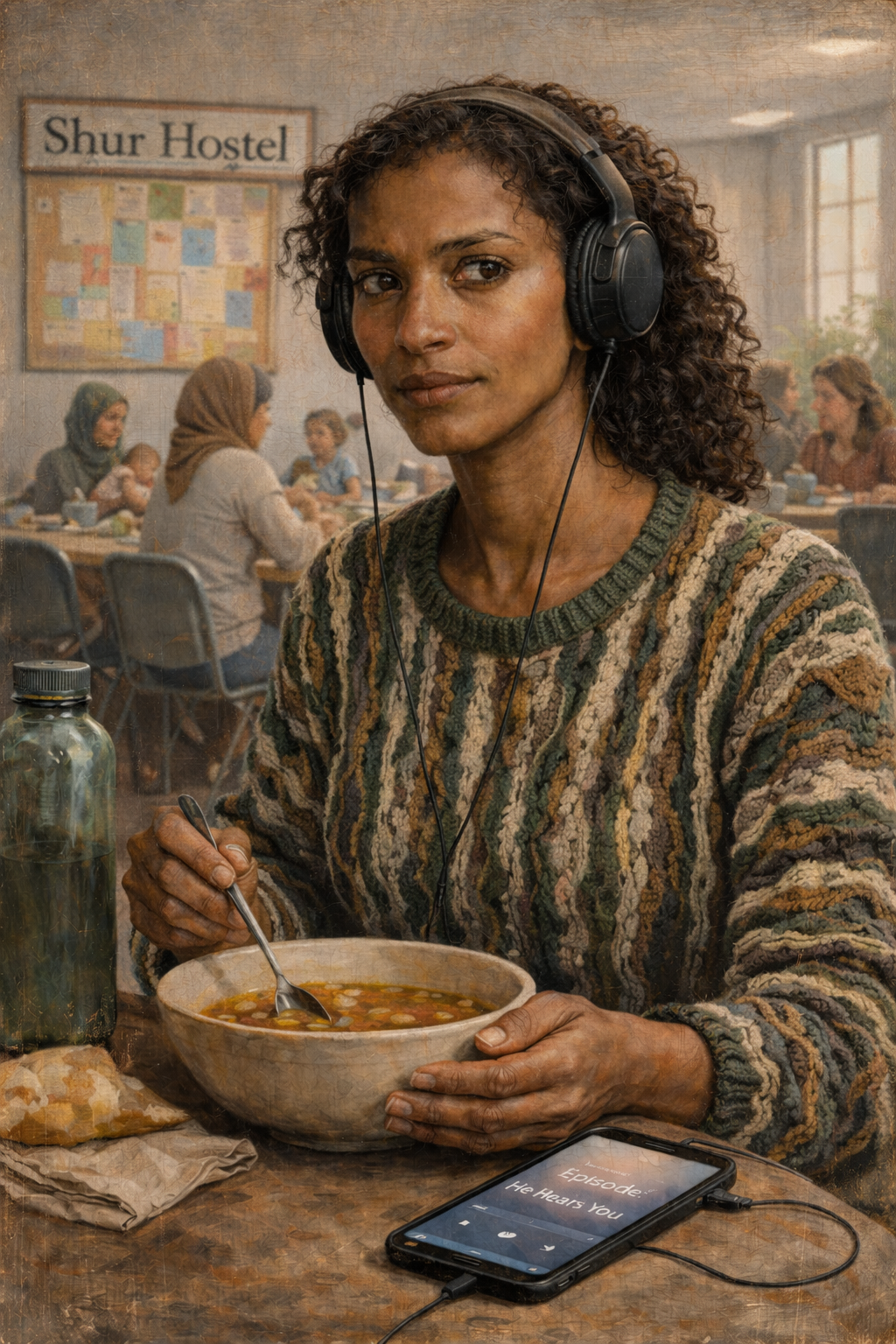
When I imagine Hagar today, I see a woman whose life is disrupted by a decision she did not make. She would lose her home, her job, and her sense of stability almost overnight, not through recklessness, but because the system she relied on failed her. I imagine her turning to state support — temporary housing, a hostel, whatever keeps her and her child safe — while she figures out how to start again with very little.
What stands out about Hagar is that even when everything is stripped away, she keeps going. She would be the kind of mother who rebuilds slowly, focused on making sure her child has what he needs, even when she doesn’t. Scripture shows her surviving displacement, raising her son in harsh conditions, and trusting a promise spoken over him when no one else was advocating for them. Today, that would look like quiet resilience — navigating forms, waiting lists, and uncertainty — all while holding onto the belief that her child’s life still matters and still has a future.
Where Hagar Appears in Scripture
Genesis 16:1–6
Hagar is introduced by name as an Egyptian servant in Sarai’s household; she conceives by Abram and is mistreated, leading her to flee.
Genesis 16:7–14
Hagar is encountered by the angel of the Lord in the wilderness; she speaks, receives a promise, and names God.
Genesis 16:15–16
Hagar gives birth to Ishmael; Abram names the child as instructed.
Genesis 21:8–14
Hagar is sent away with Ishmael after Isaac’s weaning; Abraham provides provisions and she departs.
Genesis 21:15–21
Hagar weeps in the wilderness; God hears Ishmael, opens Hagar’s eyes to a well, and the child survives and grows.
Genesis 25:12
Hagar is referenced in the genealogy of Ishmael as his mother.
Galatians 4:22–25
Hagar is referenced by Paul in an allegorical discussion contrasting two covenants.
Legacy
Within Christian tradition, Hagar has often been read through tension rather than tenderness. She is frequently encountered indirectly — through Sarah, through Abraham, or through Paul’s allegory in Galatians — and that has sometimes shifted attention away from her lived experience in Genesis. In some teachings, Hagar becomes a symbol before she is allowed to remain a person, which can flatten the weight of her story.
At the same time, many Christian readers have long recognised something unmistakable about Hagar: she is seen by God when no one else sees her. She is the first person in Scripture to receive an annunciation-style promise about a child, and the only one who names God directly — “You are a God of seeing” (Genesis 16:13). These details have made Hagar a powerful figure for Christians reflecting on suffering, displacement, and divine attention toward those on the margins.
The difficult part of Hagar’s legacy lies in how her story has sometimes been used to justify hierarchy — especially when Paul’s allegory is read without careful attention to its rhetorical purpose or its grounding in Genesis. Modern Christian scholarship increasingly emphasises that Paul’s use of Hagar is symbolic and theological, not a verdict on her worth or faithfulness. Returning to Genesis itself, readers are noticing that God hears Hagar, protects her child, and ensures her survival without rebuke or correction.
Today, Hagar’s story continues to shape Christian conversations about power, vulnerability, and God’s concern for those pushed aside by systems they did not choose. Her legacy reminds the Church that being part of God’s story does not always look like being centred — and that divine care often meets people precisely where human protection has failed.
Reply