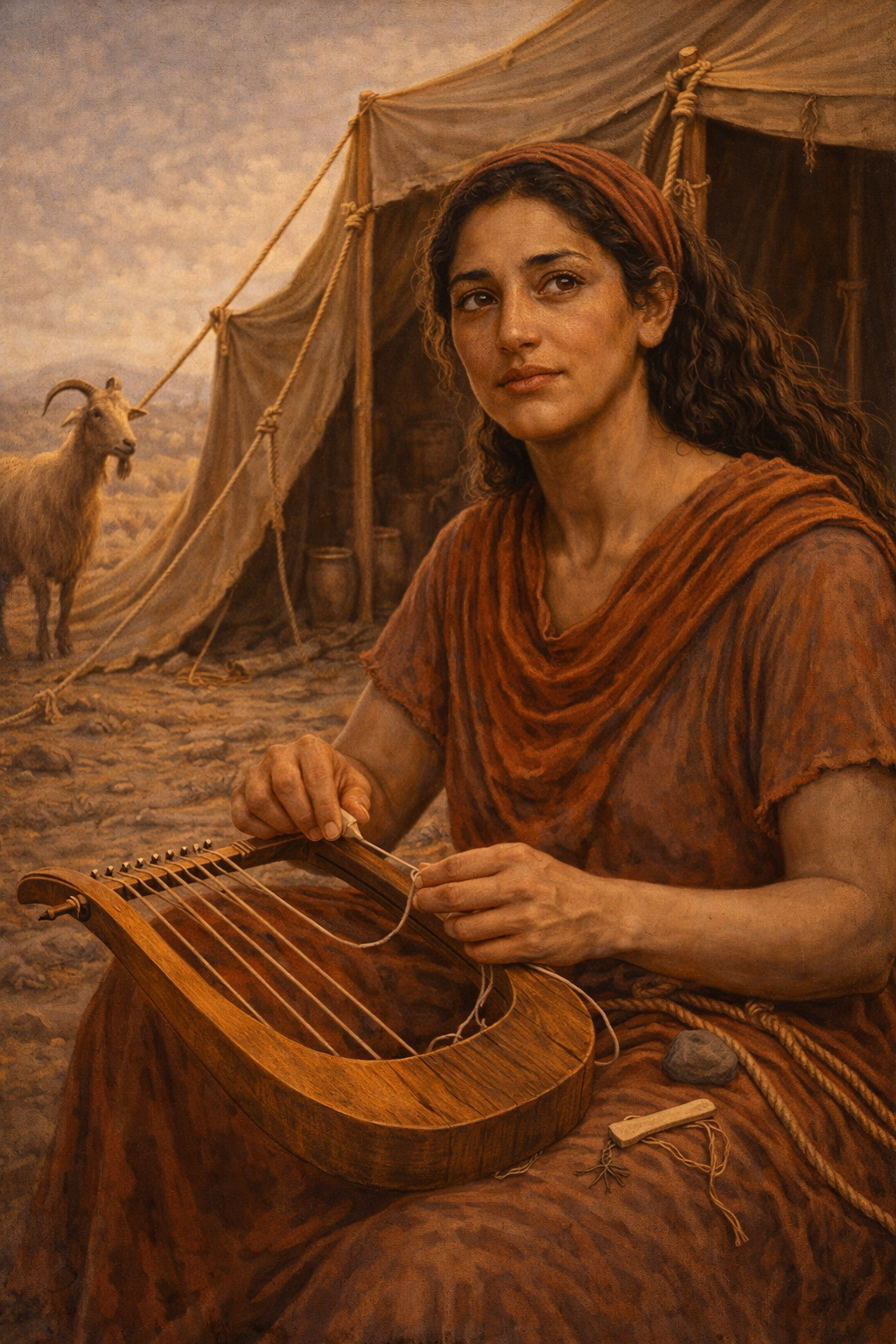
Adah’s Story
Adah enters the biblical record in Genesis 4, within the family line of Cain, only a few generations after the creation of humanity. This is a period when people are no longer simply surviving but beginning to shape patterns of work, family, and culture that will last. Adah appears at a moment when family structures themselves are changing.
Scripture introduces her directly and without embellishment:
“Lamech took two wives; the name of the one was Adah, and the name of the other Zillah” (Genesis 4:19).
Adah is the first woman named in the Bible as part of a polygamous marriage. The text does not pause to explain this arrangement or comment on it. It simply places Adah inside it and moves forward. Her story unfolds within a household that is already complex.
Adah becomes a mother, and Scripture gives particular attention to her children. It records:
“Adah bore Jabal; he was the father of those who dwell in tents and have livestock” (Genesis 4:20).
Through Jabal, Adah’s family is associated with organized herding and mobile living. This marks a shift in how people relate to land, animals, and settlement. Life is no longer confined to a single place; it becomes adaptive and skilled.
Scripture then names her second son:
“His brother’s name was Jubal; he was the father of all those who play the lyre and pipe” (Genesis 4:21).
Through Jubal, music enters the biblical record not as decoration, but as a defining human activity. Adah’s household becomes associated not only with survival and work, but with creativity and expression.
These details are not incidental. In a genealogy where many people are named without explanation, Adah’s sons are described by what they originated. Through her, Scripture traces the beginnings of everyday human life — shelter, livestock, movement, and music.
Adah’s family exists alongside that of Zillah, whose children are associated with metalwork and tools (Genesis 4:22). Together, these households represent a generation shaping the foundations of labor and culture.
Later in the chapter, Adah is addressed directly by her husband. Lamech speaks to both of his wives, saying:
“Adah and Zillah, hear my voice; you wives of Lamech, listen to what I say” (Genesis 4:23).
He goes on to speak of violence and vengeance, boasting of killing a man and escalating retaliation beyond Cain. This moment places Adah inside a household marked by both productivity and brutality — creativity alongside unchecked pride.
Scripture does not record Adah’s response. It does not tell us her thoughts or actions in this moment. What it does show is the world she is living in: one where cultural progress and moral breakdown exist side by side. Adah remains named, located, and remembered within that tension.
After this point, Adah does not appear again. Scripture does not record her death or later life. Her story closes where Genesis often closes women’s stories — not with commentary, but with legacy.
Through her sons, Adah’s life continues to shape how people live, move, work, and create.
Who Would She Be Today?

When I think about Adah today, I picture someone deeply involved in the running of her family’s life. Scripture places her in a shared marriage with Zillah, and that alone suggests a woman used to complexity — someone who understands how to hold things together when family structures are layered and demanding. I imagine her closely tied to the family’s work, not observing from the side, but making sure it functions.
Because her sons are connected to livestock and music, I see Adah as someone who understands both the practical and the cultural sides of life. She would likely be overseeing the family business — managing people, resources, and daily decisions — the kind of role that keeps everything moving even when it isn’t visible. Her strength wouldn’t come from authority or recognition, but from competence and reliability.
Adah feels like the kind of woman whose presence steadies a household. She would know the details, anticipate what’s needed, and carry responsibility without much comment. Not flashy, not distant — just central, capable, and trusted.
Where Adah Appears in Scripture
Genesis 4:19
Adah is named as one of the two wives of Lamech, marking the first recorded instance of polygamy in Scripture.
Genesis 4:20
Adah is identified as the mother of Jabal, associated with those who live in tents and raise livestock.
Genesis 4:21
Adah is identified as the mother of Jubal, associated with music and musical instruments.
Genesis 4:23
Adah is addressed directly by Lamech in a spoken declaration to both of his wives.
Legacy
Within Christian tradition, Adah has often been overlooked, largely because she appears in a genealogy rather than a dramatic narrative. When she is mentioned, it is usually in connection with polygamy, and her story has sometimes been flattened into a footnote about family structures rather than explored on its own terms. This focus can obscure what the text actually preserves about her.
At the same time, Adah’s legacy has been quietly affirmed through what Scripture chooses to remember. Her name is recorded. Her children are named. Their contributions to human life — livestock management and music — are traced back to her. Christian readers have not always lingered on this, but it reflects a biblical pattern of honoring foundations rather than spectacle.
Some later interpretations have read Adah primarily through Lamech’s violence, allowing his actions to overshadow her presence. Modern Christian scholarship increasingly resists this move, returning to the text itself and noting that Adah is not defined by her husband’s speech but by the life that comes through her. Today, her story invites Christians to reconsider how influence, creativity, and endurance are valued — reminding us that God’s purposes often unfold through women whose work is structural rather than celebrated.
Adah’s legacy continues to shape faith conversations by challenging assumptions about whose stories matter and how quietly formative lives are remembered in Scripture.
Reply