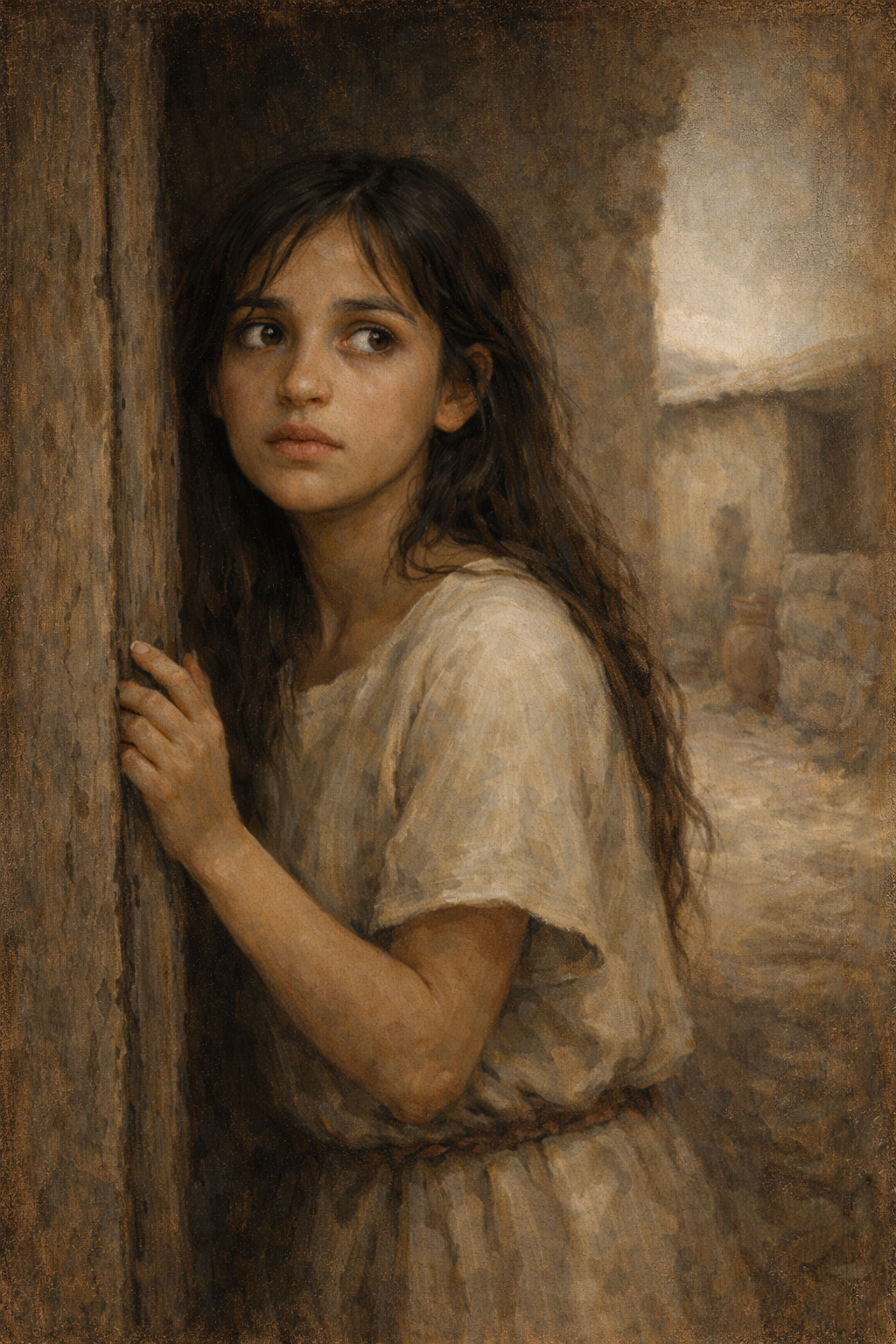
Themes on sexual abuse
Dinah’s Story
Dinah is introduced as the daughter of Leah, whom she bore to Jacob. Jacob is the son of Isaac and grandson of Abraham, living with a large and expanding household in the land of Canaan. By the time Dinah is born, Leah has already given Jacob six sons. Dinah grows up surrounded by brothers, the only daughter named among them, living within a family shaped by rivalry between mothers and by the constant presence of men. Scripture names her once at her birth (Genesis 30:21), then does not return to her until she is old enough to move about on her own.
Dinah’s mother, Leah, is a woman accustomed to being overlooked, and Dinah grows up within that part of the household — not the favored tent, but the one defined by endurance and persistence. As the only daughter, Dinah’s daily life would have been closely tied to women’s work and women’s space, yet she lives on the edge of a world dominated by her brothers’ movements, their authority, and their reactions. Scripture gives no description of her childhood, but it places her clearly within a crowded, male-centered family where her protection depends on others.
As Jacob settles near the city of Shechem, Dinah goes out “to see the women of the land.” (Genesis 34:1) The text offers no explanation beyond this. She is not described as reckless or disobedient. She is doing something ordinary — stepping beyond her family’s encampment to observe the lives of other women.
What follows is described plainly and without mitigation. Shechem, the son of Hamor, sees her, “seizes her, and lay with her, and humiliated her.” (Genesis 34:2) Scripture names the act as violence. Dinah does not speak. Nothing in the text suggests consent or choice.
After the assault, Shechem’s desire turns toward attachment. Scripture says, “His soul was drawn to Dinah… and he loved the young woman and spoke tenderly to her.” (Genesis 34:3) He asks his father to arrange a marriage. Hamor goes to Jacob to negotiate. Jacob hears that his daughter has been defiled, and the text notes that he remains silent until his sons return from the field. (Genesis 34:5) Dinah’s father does not speak publicly on her behalf.
When Dinah’s brothers hear what has happened, they are described as “grieved and very angry.” (Genesis 34:7) The harm done to their sister is understood as an outrage against their family. Hamor proposes intermarriage and shared land. Shechem adds his own appeal, saying, “Let me find favor in your eyes… ask me for as great a bride-price and gift as you will.” (Genesis 34:11–12) Dinah’s future is discussed entirely by men. Her voice is not recorded.
Jacob’s sons answer deceitfully, agreeing to marriage if every male in the city is circumcised. Hamor and Shechem consent and persuade the city to comply. On the third day, when the men are in pain, **Simeon and Levi, Dinah’s full brothers, take swords, enter the city, and kill every male. They kill Hamor and Shechem and take Dinah out of Shechem’s house. (Genesis 34:25–26)
The violence spreads beyond Shechem himself. The other sons of Jacob plunder the city, taking livestock, goods, women, and children. Jacob confronts Simeon and Levi, saying, “You have brought trouble on me… I shall be destroyed.” (Genesis 34:30) His concern is the family’s safety. Simeon and Levi answer, “Should he treat our sister like a prostitute?” (Genesis 34:31) Scripture records the exchange without judgment or resolution.
Dinah returns to her family. Scripture does not record her words, her grief, or how her life unfolds afterward. She is named once more in a genealogy, listed among Leah’s children when Jacob’s household goes down to Egypt. (Genesis 46:15) No marriage, children, or death are recorded for her.
Dinah’s story is shaped by her place within a large family — a daughter among many sons, a woman whose life is acted upon by others. Scripture does not soften what is done to her, and it does not present the violence committed in response as clean or redemptive. Dinah remains in the biblical record as a daughter whose suffering is real, whose silence is preserved, and whose life continues without narrative repair.
Dinah’s story in Genesis 34 unfolds within a cultural world where a father’s role was to negotiate protection, honour, and marriage for his daughter, especially after harm had been done. When Jacob hears that Dinah has been violated, Scripture records his response with unsettling restraint: “Jacob heard that his daughter Dinah had been defiled, but his sons were in the fields with his livestock; so he kept silent until they came home.” That silence has troubled readers for centuries, and it matters.
Jacob’s quiet is not presented as wisdom or approval. It reflects a form of complacency shaped by fear, caution, and calculation. As a resident foreigner near Shechem, Jacob is vulnerable. His household is large but not politically secure. Speaking too quickly could provoke violence. Waiting, in his mind, may have felt like prudence. But Scripture does not frame his silence as protection for Dinah — it simply records it, and the consequences that follow.
In that world, when a young woman was sexually violated, marriage negotiations were often used as the social mechanism to resolve the crisis. This did not mean the harm was denied; it meant the family sought to restore honour, security, and future stability through formal union and compensation. This is exactly what Shechem and his father Hamor propose: marriage, bride-price, land, and integration. From their perspective, this was a way to contain the damage and move forward.
Dinah becomes wrapped up in this process because she is the centre of the negotiation but not a participant in it. Her body and future are discussed entirely by men — her father, her brothers, Shechem, and Hamor. Marriage is treated as a solution, revenge as a counter-solution, and Dinah is caught between them. Jacob hesitates. Her brothers act decisively and violently. Both responses happen around her rather than with her.
Scripture never tells us that Dinah wanted marriage, nor that she rejected it. It never tells us how she understood her father’s silence. What it does show is a young woman whose suffering becomes the ground on which adult men argue about honour, power, and survival. Jacob’s complacency and the brothers’ revenge are not presented as opposite moral poles — they are shown as two inadequate responses to a situation that demanded care, protection, and restraint.
Who Would She Be Today?

Dinah’s story shines a harsh light on child sexual abuse and the devastating way it can fracture families.
If Dinah were around today, I think she’d be someone who learned far too young what it feels like when adults get it wrong. Not just the adult who crossed a line, but the ones who were meant to step in, slow things down, and protect her — and didn’t. She’d be deeply loved, absolutely cherished, and still caught in the middle of a family trying to work out what justice even looks like after something unthinkable happens. You can imagine her sitting in rooms where people argue about her, making big, loud decisions, while she’s quietly carrying the cost of all of it.
She’d grow up holding not just her own story, but her family’s response to it. The adults around her acted in the ways they believed were right — negotiating, defending, retaliating — and yet those choices led to destruction rather than healing. Dinah today would understand, painfully and clearly, that being protected isn’t the same as being safeguarded, and that revenge can wound the very person it claims to defend. Scripture doesn’t tell us what became of her, and that restraint matters. It leaves us with a question rather than an ending: how do we protect the young people in our care with wisdom and humility, and how do we resist responses that multiply harm instead of tending what was already broken?
Where Dinah Appears in Scripture
Genesis 30:21 — Born to Jacob and Leah; named Dinah.
Genesis 34:1 — Goes out to see the daughters of the land.
Genesis 34:2 — Taken and violated by Shechem, son of Hamor.
Genesis 34:3 — Shechem’s attachment to Dinah is described.
Genesis 34:5 — Jacob hears that Dinah has been defiled.
Genesis 34:7 — Dinah’s brothers learn what happened and are grieved and angry.
Genesis 34:13 — Her brothers speak deceitfully to Shechem and Hamor because of Dinah.
Genesis 34:25–26 — Simeon and Levi kill the men of the city; Dinah is taken out of Shechem’s house.
Genesis 34:27 — Jacob’s sons plunder the city because Dinah had been defiled.
Genesis 34:31 — Dinah is referenced by her brothers in defense of their actions.
Genesis 46:15 — Listed as Leah’s daughter among Jacob’s household entering Egypt.
Legacy
Within Christian teaching and interpretation, Dinah’s story has often been spoken about more than she is allowed to speak in Scripture itself. For centuries, her name has appeared primarily in discussions of sexual sin, family honor, or communal violence, with the focus frequently shifting away from her and onto the actions of the men around her.
Historically, some Christian readings have treated Dinah as a cautionary figure, emphasizing her going out “to see the daughters of the land” while drawing conclusions the text itself does not state. In these readings, responsibility subtly moves toward her, despite Scripture never assigning her blame, intention, or motive. This approach has created tension, especially where moral warnings were built on silence rather than explicit biblical testimony.
At the same time, Christian tradition has also recognized the gravity of what was done to her. The language of Genesis 34 — “defiled” — has been taken seriously in many theological discussions, affirming that a real violation occurred and that it mattered deeply within Israel’s moral framework. Her brothers’ anger has often been read as evidence that her dignity had been violated, even when their response is acknowledged as morally complex and troubling.
A persistent difficulty in Christian reflection on Dinah is that her story ends without resolution. She is taken out of Shechem’s house, and then the narrative moves on. No restoration is described. No future is recorded. For some interpreters, this silence has been uncomfortable, leading to attempts to fill gaps the text leaves open. Others have allowed the silence to stand, recognizing it as part of the biblical record rather than a problem to solve.
In more recent Christian scholarship and teaching, there has been a deliberate return to the text itself. Modern readers are increasingly resisting interpretations that go beyond what Scripture says and are instead reading Dinah carefully, minimally, and honestly — noticing what is present, what is absent, and how often her story has been shaped by assumptions rather than verses. This shift has opened space for conversations about trauma, silence, justice, and the cost borne by women whose lives are altered without their consent.
Today, Dinah’s legacy continues to shape Christian conversations about how Scripture is read, how silence is handled, and whose voices are centered. Her story presses readers to ask not only what the Bible says, but how faithfully it is allowed to speak — and where later interpretations may have spoken too loudly in its place.
Reply