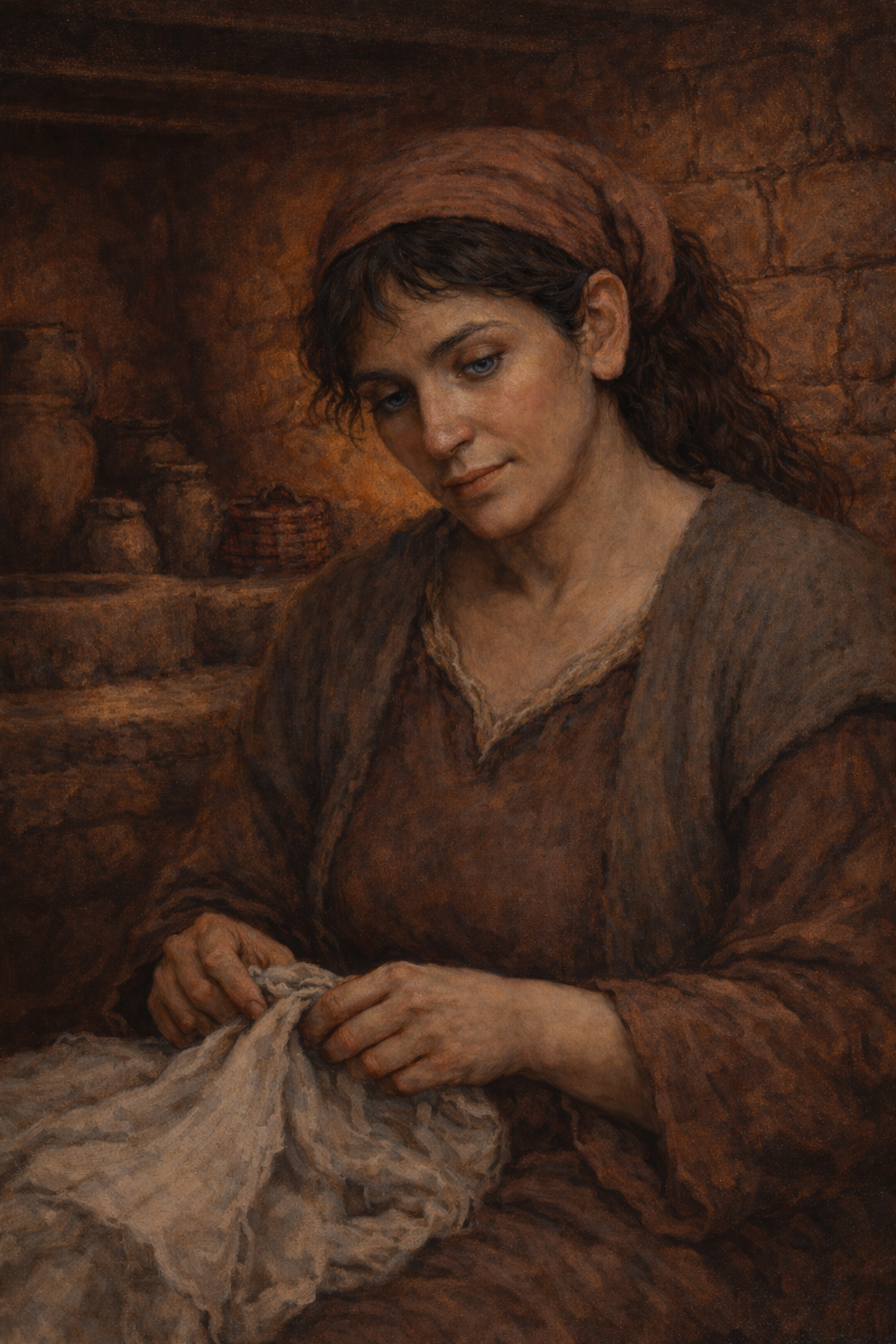
Leah’s Story
Leah is introduced within a family shaped by hierarchy and negotiation. She is the older daughter of Laban, living in Paddan-aram, and the sister of Rachel. Scripture distinguishes the sisters without explanation: “Leah’s eyes were weak, but Rachel was beautiful in form and appearance.” (Genesis 29:17) From the outset, Leah is known in relation to comparison, not preference.
When Jacob comes to Laban’s household and works seven years to marry Rachel, Leah’s life is altered by a decision she does not initiate. On the wedding night, Laban gives Leah to Jacob instead. Morning reveals the truth. Jacob confronts Laban, and Laban answers that the custom of the place requires the firstborn to be married before the younger. (Genesis 29:23–26) Leah enters marriage through deception carried out by her father, and she remains in that marriage as the less-loved wife. Scripture names the reality plainly: “When the LORD saw that Leah was unloved…” (Genesis 29:31)
What follows is not silence. Leah bears children, and Scripture records her words carefully. With the birth of her first son, she names him Reuben, saying, “Because the LORD has looked upon my affliction; for now my husband will love me.” (Genesis 29:32) With each birth, Leah speaks her hope and her grief. Simeon is born, and she says, “Because the LORD has heard that I am hated, he has given me this son also.” Levi follows, and Leah says, “Now this time my husband will be attached to me.” (Genesis 29:33–34) Leah’s longing is direct and honest. She wants to be loved, and she names that desire without disguise.
With the birth of her fourth son, something shifts. Leah names him Judah, saying, “This time I will praise the LORD.” (Genesis 29:35) The statement stands on its own. Praise replaces petition. Scripture does not say her circumstances change, but her speech does. Leah pauses childbearing after Judah, and the household tension continues as Rachel, still barren, gives her servant to Jacob.
Later, Leah resumes bearing children. She gives her servant Zilpah to Jacob, and through Zilpah, two sons are born. Leah then bears Issachar, Zebulun, and finally a daughter, Dinah. (Genesis 30:9–21) Leah’s household grows large. She carries the work of motherhood, the complexity of rivalry, and the responsibility of sustaining family life within a divided marriage.
Scripture records a moment of negotiation between the sisters that reveals Leah’s position clearly. When Rachel desires mandrakes found by Leah’s son, Leah answers her, “Is it a small matter that you have taken away my husband? Would you take away my son’s mandrakes also?” (Genesis 30:15) Leah speaks with clarity about loss that has accumulated over time. Her words are not sharp for effect; they are grounded in lived reality.
Leah’s story does not end in obscurity. When Jacob prepares to meet his brother Esau, Leah and her children are placed after the servants but before Rachel. (Genesis 33:1–2) Later, when Jacob gives his final blessings, Judah receives a promise of leadership: “The scepter shall not depart from Judah.” (Genesis 49:10) Through Leah’s son, kingship is named. Through her line, Israel’s future is shaped.
Leah dies and is buried in the cave of Machpelah, the ancestral burial place, alongside Abraham and Sarah, Isaac and Rebekah. (Genesis 49:31) Rachel is buried elsewhere. Leah rests within the family tomb.
Leah’s life is marked by endurance rather than reversal. She is not rescued from rivalry or granted the affection she longs for. She continues — bearing children, speaking honestly, naming both pain and praise. Scripture does not minimize her grief, and it does not overlook her contribution. Leah becomes the mother of half the tribes of Israel and the ancestor of kings. Her story shows that faithfulness can grow in unwanted places, and that lasting legacy is sometimes formed not through being chosen, but through continuing to live, speak, and praise within what is given.

Leah is someone you probably bump into all the time. On the school run, at the park with her boys. Even before having children, she always seems to have things under control. She’s grown up knowing that people rely on her, as the eldest sister. She’s the kind of person who learned early how to be responsible and dependable, because someone had to be.
Leah feels like the eldest child who grew up doing what was expected. Following the rules. Helping out. Not causing trouble. At home, she’s often the priority because she’s the oldest — the one things fall back on — and that brings its own kind of pressure and conflict. At the same time, she lives with the constant awareness of her sister, who has always been the “beautiful one”. That comparison never really leaves her. It shapes how she sees herself, even as she keeps showing up and getting things done.
She doesn’t fight back, and she builds a life that is expected of her. The husband, the children, the house and the routine, even if it does make people close to her feel uncomfortable. She pours herself into her children and her responsibilities, finding meaning in what she carries. And yet, there’s always that quiet sense of living in someone else’s shadow — valued in one space, overlooked in another. Leah’s story feels deeply familiar. It reminds us that a lot of people live faithfully without rebellion, without recognition, doing what’s asked of them day after day. And sometimes the courage isn’t in pushing against the system, but in continuing to live, love, and hold things together, even when the balance never quite feels fair.
Where Leah Appears in Scripture
Genesis 29:16–17
Leah is introduced as the older daughter of Laban and sister of Rachel; Scripture distinguishes her from Rachel.
Genesis 29:23–25
Leah is given to Jacob in marriage through Laban’s deception; Jacob discovers the truth the following morning.
Genesis 29:31–35
Leah bears four sons — Reuben, Simeon, Levi, and Judah — and speaks at each birth, naming her affliction, longing, and praise.
Genesis 30:9–13
Leah gives her servant Zilpah to Jacob; two sons (Gad and Asher) are born through Zilpah, and Leah speaks in naming them.
Genesis 30:15–21
Leah speaks during the mandrakes exchange with Rachel; she later bears Issachar, Zebulun, and a daughter, Dinah, and names them.
Genesis 33:1–2
Leah appears with her children when Jacob arranges his family before meeting Esau.
Genesis 35:23
Leah’s sons are listed as part of Jacob’s household.
Genesis 46:15
Leah is named in the genealogy of Jacob’s family entering Egypt, along with her sons and daughter Dinah.
Genesis 49:31
Leah’s burial is recorded; she is buried in the cave of Machpelah with the patriarchs and matriarchs.
Legacy
Within Christian tradition, Leah has often been approached through comparison — measured against Rachel, introduced as the less-loved wife, and remembered first for what she lacked rather than what she carried. Sermons and teaching have frequently emphasized her rejection and longing for affection, sometimes reducing her story to a lesson about unmet desire or perseverance in disappointment. While these readings are not wrong, they have often stopped short of engaging the full weight of her life and contribution.
At the same time, Leah has been deeply honored in Christian theology for her place in God’s redemptive history. She is the mother of Judah, from whom David and, ultimately, Jesus are descended. This has made her a quiet but central figure in salvation history. Christian reflection has long noted the significance of Leah’s words at Judah’s birth — “This time I will praise the LORD” — as a turning point where worship emerges not from changed circumstances, but from faith formed within hardship.
Some interpretations have gone beyond the text by portraying Leah’s suffering as something God deliberately imposed to teach her contentment, or by suggesting that her value lies primarily in being compensated for rejection through fertility. These readings risk flattening her story and overlooking her agency. Scripture does not present Leah as passive or unaware; it records her speech, her naming of pain, and her capacity to praise without erasing the grief that precedes it.
In more recent Christian scholarship and teaching, Leah is being read with greater attentiveness and respect. Readers are recognizing her as a woman who speaks clearly, works faithfully, and endures without silence. Her legacy now shapes conversations about how God’s purposes unfold through those who are overlooked, how worship can coexist with sorrow, and how significance in Scripture is not limited to being chosen or preferred. Leah’s story continues to invite Christians to see faith not as escape from suffering, but as something formed and spoken honestly within it.
Reply