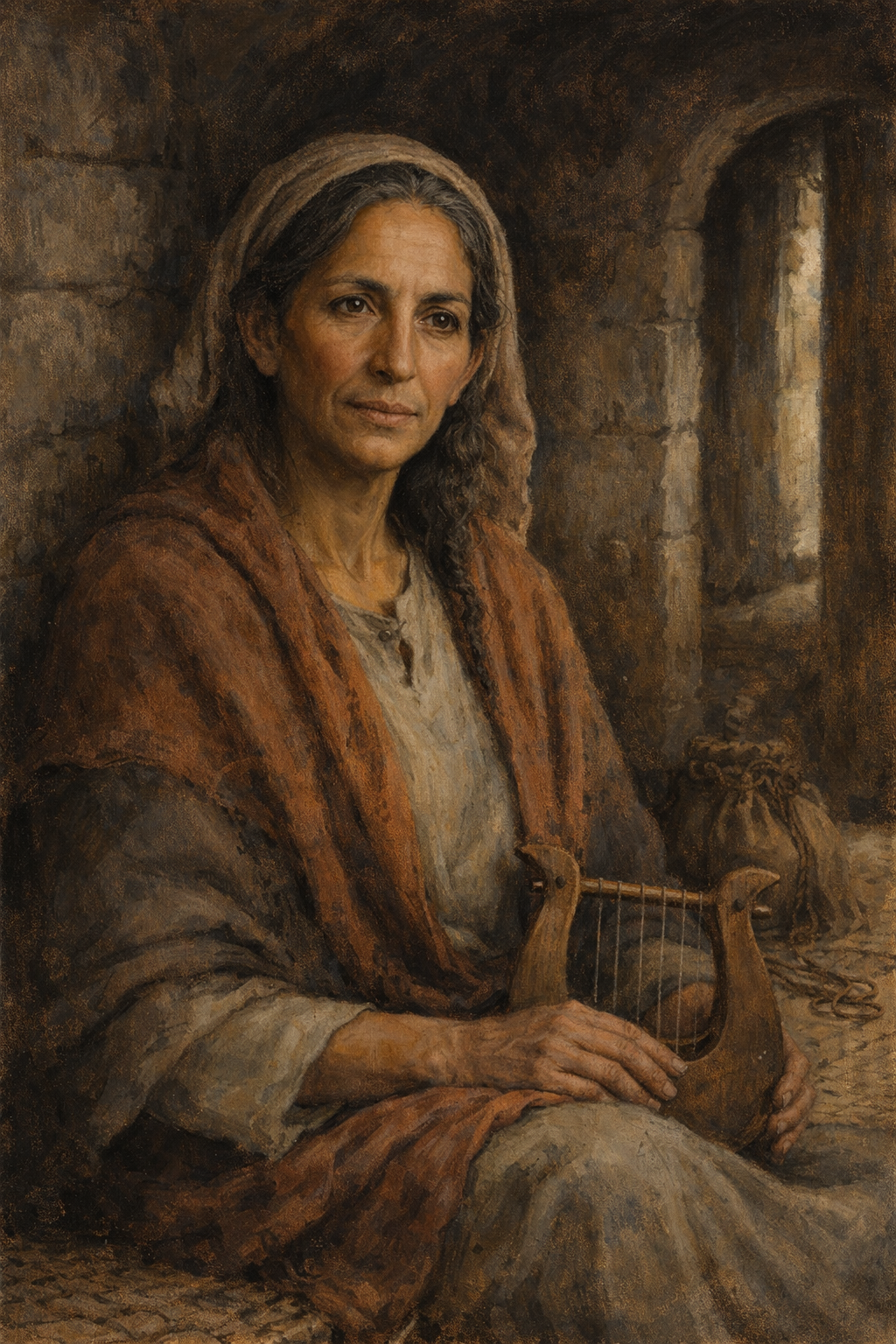
Serah’s Story
Serah appears in Scripture briefly, but deliberately. She is named as Serah, the daughter of Asher, who is one of the twelve sons of Jacob. Her name is recorded when Jacob’s extended family is listed as they enter Egypt during the famine. Scripture states simply: “The sons of Asher: Imnah, Ishvah, Ishvi, Beriah, with Serah their sister.” (Genesis 46:17) In a genealogy dominated by sons, Serah is named directly and individually. She is not absorbed into a household label; she is spoken aloud.
Serah belongs to a large family moving under pressure. Jacob and his sons are leaving Canaan and settling in Egypt, carrying grief, loss, and uncertainty alongside survival. Serah enters the biblical record as part of that transition. Scripture does not describe her age, her work, or her words, but it places her inside a family on the move, living among brothers, uncles, cousins, and elders, all adjusting to life in a foreign land.
Years later, Serah is named again. When the tribes of Israel are counted in the wilderness generations afterward, Scripture repeats her name: “The name of the daughter of Asher was Serah.” (Numbers 26:46) This repetition is striking. Many women are unnamed in genealogies, yet Serah is remembered across generations. Her life spans time, movement, and change, and Scripture preserves her presence when it could easily have let it fade.
Serah’s story contains no recorded speech and no recorded actions. Instead, it preserves her name. In a record focused on inheritance and tribal continuity, Serah stands as a quiet constant — a daughter named, remembered, and carried forward in the memory of the people. Later scholars and interpreters have noted that this preservation suggests a life that likely spanned significant change: migration into Egypt, the growth of Israel from family to people, and the passing of generations. While Scripture does not describe what Serah witnessed, it allows for the possibility that she lived long enough to see much — holding memory rather than power, continuity rather than prominence.
Although Scripture itself says very little about Serah, later Jewish tradition noticed her repeated appearance in genealogies and began to ask why her name was preserved when so many others were not. Rabbinic literature, particularly in midrashic texts, expanded Serah’s story far beyond the biblical record, portraying her as exceptionally long-lived and present at key moments in Israel’s history. In some traditions, she is said to have lived from the time of Jacob into the period of Moses, and even to have helped identify Joseph’s coffin during the Exodus. These traditions treat her as a living link between generations, a bearer of memory rather than power.
It is important to note that none of these details appear in Scripture itself. They represent interpretive reflection rather than historical expansion. Scholars generally agree that these traditions arise from a genuine textual observation: Serah’s name is repeated across generations, which is unusual, and suggests that she was remembered intentionally. Later interpreters filled the silence with meaning, using Serah to symbolize continuity, faithfulness, and the preservation of communal memory.
In Christian scholarship, Serah has received far less attention, often remaining confined to genealogical study. Where she is discussed, it is usually to highlight how Scripture occasionally preserves women’s names without explanation, reminding readers that significance in the biblical text is not always tied to action or speech. Modern biblical scholars tend to resist adding narrative detail to Serah’s life, instead emphasizing the restraint of the text itself and the importance of not confusing later tradition with biblical witness.
Today, Serah is often cited in academic and theological conversations as an example of how Scripture remembers some women simply by naming them — not as symbols or lessons, but as people whose lives were part of the story even when the details are not given. Her legacy, both biblical and interpretive, continues to shape discussions about memory, transmission of faith, and the limits of what Scripture chooses to reveal.
Who Would She Be Today?

If Serah lived today, she’d be someone who has always been close to the center of things — part of a large, influential family where conversations matter and history is being made in real time. She’d grow up surrounded by people of significance, listening closely, remembering details, and noticing patterns others miss. Scripture’s decision to preserve her name, and scholars’ later attention to her life, suggest a woman who saw a great deal simply by being present across generations, carrying memory when others moved on.
Later in life, Serah would finally share what she’s seen. Maybe it’s a book, maybe talks or interviews, but when she speaks, people listen — because her insight comes from having lived alongside change rather than chasing attention. You’d meet her at a book signing and feel grateful she chose to speak at all, realizing how much wisdom can come from women whose lives were woven into the story even when they weren’t foregrounded. Serah would leave you inspired by the idea that showing up, staying attentive, and remembering faithfully can shape history just as powerfully as action.
Where Serah Appears in Scripture
Genesis 46:17
Serah is named as the daughter of Asher when Jacob’s household is listed as it enters Egypt during the famine.
Numbers 26:46
Serah is named again as the daughter of Asher in the census of Israel taken in the wilderness.
Legacy
Within Christian tradition, Serah has often received little attention, largely because her story contains no dramatic events, recorded speech, or moral turning points. She is usually mentioned only in genealogies, and in many church settings her name is passed over quickly, treated as a minor detail in a larger family record. This has sometimes led to the assumption that her significance is minimal, when in fact her repeated naming is itself unusual and intentional.
Where Serah has been noticed, Christian readers have often appreciated her as a reminder that Scripture values continuity as much as action. Her presence challenges the tendency to equate importance with visibility or achievement. Unlike figures whose faith is marked by crisis or decision, Serah’s legacy rests in being remembered across generations, quietly held within the story of Israel as it moves from family to nation.
At the same time, later interpretations — especially in Jewish tradition — have expanded Serah’s life far beyond the biblical text, portraying her as extraordinarily long-lived and present at pivotal moments in Israel’s history. While these traditions reflect a deep respect for her remembered name, Christian scholarship generally distinguishes clearly between Scripture and later reflection, noting that such expansions are imaginative responses rather than biblical claims.
In recent years, Christians have begun to read Serah more carefully and more patiently. Rather than asking why so little is said about her, readers are asking why her name is preserved at all. Her legacy now contributes to broader faith conversations about memory, presence, and the kinds of lives Scripture chooses to honor. Serah stands as a reminder that being named, remembered, and carried forward can itself be a form of significance — one that does not depend on drama, explanation, or resolution.
Reply