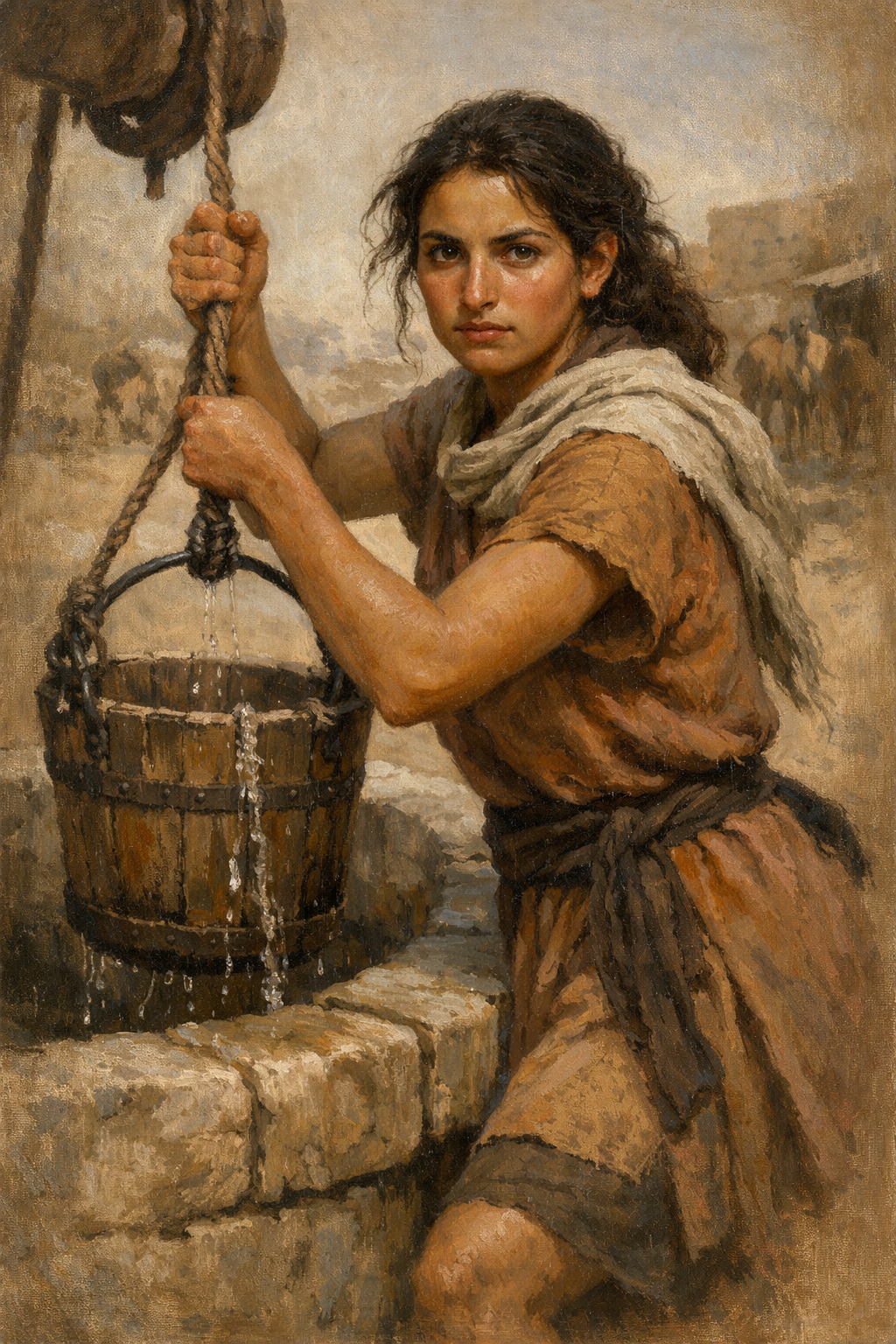
Rebekah’s Story
Rebekah enters the biblical story decisively, not as background to someone else’s life, but as a woman whose actions immediately shape the future. She appears in Genesis 24, introduced by name, lineage, and family: she is the daughter of Bethuel, the granddaughter of Nahor, Abraham’s brother. She belongs to Abraham’s extended family in Mesopotamia, a household already woven into the larger story of promise.
Her first appearance is not in a home, but at a well.
Abraham’s servant arrives in her region with a clear task: to find a wife for Isaac, Abraham’s son. He prays for a specific sign — that the right woman will offer him water and also draw water for his camels. Before the prayer is finished, Rebekah arrives. Scripture pauses to describe her clearly and without apology: she is young, capable, and active. When the servant asks for a drink, she answers simply, “Drink, my lord,” and then adds, “I will draw water for your camels also, until they have finished drinking” (Genesis 24:18–19).
This is not a small gesture. Drawing water for camels is demanding, physical work. Rebekah does it quickly and without being asked twice. The servant watches in silence as she finishes the task completely. Her competence speaks before anyone else does.
When the servant asks about her family, Rebekah answers plainly and offers hospitality: “We have plenty of both straw and fodder, and room to spend the night” (Genesis 24:25). She runs home and tells her family what has happened. The decision that follows is communal, but Rebekah is not silent within it. When her family asks her directly, “Will you go with this man?” she answers with clarity: “I will go” (Genesis 24:58).
That sentence carries weight. Rebekah leaves her home, her family, and her familiar world to marry a man she has not met, stepping into a promise she did not initiate but fully accepts.
She arrives in Canaan and meets Isaac. Scripture records the moment briefly and tenderly: Isaac brings her into his mother Sarah’s tent, and “she became his wife, and he loved her” (Genesis 24:67). Rebekah’s marriage is marked not by transaction, but by affection and continuity.
Years pass. Rebekah does not conceive.
Scripture does not rush past this. It states plainly that Isaac prays because his wife is barren, and the Lord responds (Genesis 25:21). Rebekah becomes pregnant, but the pregnancy is difficult. The struggle inside her is intense enough that she seeks understanding: “If it is thus, why is this happening to me?” (Genesis 25:22). She goes to inquire of the Lord, and God answers her directly, explaining that two nations are within her, and that the older will serve the younger.
Rebekah carries knowledge that shapes everything that follows.
She gives birth to twins. Esau is born first, red and hairy. Jacob follows, grasping his brother’s heel. As they grow, their differences sharpen. Esau becomes a hunter, often away, living by skill and strength. Jacob stays near the tents. Scripture states plainly that “Isaac loved Esau… but Rebekah loved Jacob” (Genesis 25:28). This is not framed as ideal. It is presented as reality — a divided household shaped by preference and proximity.
Rebekah watches her sons grow into opposition. She knows what God has spoken about them. She also watches Isaac’s affection settle increasingly on Esau, the firstborn, the expected heir.
When Isaac is old and blind, he prepares to bless Esau. He sends him out to hunt and prepare food, intending to pass on the primary blessing before his death. Rebekah hears this plan (Genesis 27:5). What Isaac intends contradicts what God has already revealed to her.
Rebekah acts.
She calls Jacob and explains what she has heard. She prepares the meal herself, dresses Jacob in Esau’s clothing, and positions him to stand before his father. When Jacob hesitates, afraid of being discovered and cursed, Rebekah answers firmly: “Let your curse be on me, my son; only obey my voice” (Genesis 27:13). She takes responsibility for the outcome.
The blessing is given. When Esau returns and discovers what has happened, the household breaks open. Esau weeps bitterly. Isaac trembles violently. Rebekah hears Esau’s plans for revenge and intervenes again. She sends Jacob away to her family, framing it as a temporary separation — but Scripture never records her seeing him again (Genesis 27:42–45).
Rebekah secures the promise. She loses daily life with her son.
Her story does not end with resolution or reunion. It ends with a woman who leaves home once, protects her child twice, and lives with the cost of what she knows to be true.
Scripture does not record Rebekah’s death in detail. Her life fades quietly from the narrative, even as the future she helped shape unfolds exactly as God said it would.
Rebekah’s story is one of discernment, courage, and consequence — a woman who listens, understands, and acts, even when the cost is personal and enduring.

When I imagine Rebekah today, I see a woman who has learned through experience how the world actually works. She wouldn’t be loud about it, but she’d be sharp — the kind of person who understands systems because she’s spent time inside them, watching where they hold and where they fail. Scripture shows her listening carefully, asking questions when something doesn’t make sense, and acting when she believes something truly matters.
I imagine her deeply involved in community or charity work, not because it looks good, but because she feels responsible for what she knows. She would be the one who volunteers consistently, notices what’s missing, and eventually steps into leadership simply because someone needs to. At the same time, she would be raising her sons — juggling work, responsibility, and sacrifice — making choices that shape their future even when it costs her personally. Rebekah feels like someone who carries weight quietly, makes hard decisions thoughtfully, and lives with intention rather than impulse.
Where Rebekah Appears in Scripture
Genesis 22:20–23 — Rebekah is named in the genealogy of Nahor, identifying her family line before her story begins.
Genesis 24:15–67 — Rebekah meets Abraham’s servant at the well, offers water, is identified as the chosen wife for Isaac, consents to leave her family, travels to Canaan, and marries Isaac. (She speaks multiple times.)
Genesis 25:20–26 — Rebekah is identified as Isaac’s wife; she experiences barrenness, conceives after Isaac’s prayer, inquires of the Lord during her difficult pregnancy, and gives birth to twins, Esau and Jacob. (She speaks.)
Genesis 25:27–28 — Rebekah’s relationship with her sons is described; she loves Jacob.
Genesis 27:1–17 — Rebekah overhears Isaac’s plan to bless Esau and instructs Jacob on how to receive the blessing instead. (She speaks extensively.)
Genesis 27:18–29 — Rebekah prepares the meal and clothing that enable Jacob to receive Isaac’s blessing.
Genesis 27:42–45 — Rebekah learns of Esau’s plan to kill Jacob and urges Jacob to flee to her family in Haran. (She speaks.)
Genesis 27:46 — Rebekah speaks to Isaac, urging him to send Jacob away to find a wife among her relatives.
Genesis 28:1–5 — Rebekah is indirectly involved as Isaac sends Jacob to her family in Paddan-aram.
Genesis 49:31 — Rebekah is named as buried in the cave of Machpelah with Isaac and other family members.
Romans 9:10–12 — Rebekah is referenced in the New Testament in connection with God’s word about her sons before their birth.
Legacy
Within Christian tradition, Rebekah has often been remembered for her decisiveness — sometimes admired, sometimes questioned. Her willingness to act when Isaac prepares to bless Esau has placed her at the center of long debates about obedience, deception, and faith. In some readings, she has been framed narrowly as manipulative or overreaching, with her actions reduced to a single moment rather than understood within the full arc of her life.
At the same time, many Christian interpreters have recognised that Rebekah is the only person in the household who explicitly receives God’s word about her sons before they are born. Her actions in Genesis 27 do not arise from ambition alone, but from knowledge — knowledge that places her in a position of responsibility. Scripture records God’s declaration to her directly, and later Christian reflection has increasingly taken that seriously, asking what it means for a woman to carry divine insight that others in her household do not.
There has also been tension around the cost of her choices. Rebekah secures the blessing for Jacob, but she loses daily life with him. Christian readers have noted that the story does not present her actions as consequence-free, nor does it undo them. Instead, Scripture allows both truth and loss to stand together. This has led many modern readers to move away from simple moral categories and toward a more honest reading of her story as one shaped by discernment under pressure.
In more recent Christian conversations, Rebekah is increasingly read as a woman who listens, understands, and acts within a complex family system — not as an idealised figure, but as a faithful one. Her legacy continues to shape discussions about agency, responsibility, and the difficult space between trusting God’s promise and navigating human relationships. Rebekah’s story remains challenging precisely because it refuses to be tidy, and Christians continue to return to it as they wrestle with what faithfulness looks like when clarity comes with cost.
Reply